

What Is The Main Function Of Inventory Management?
Reviewed and updated: October 2026
The main function of inventory management is to make sure the right products are available in the right place, at the right time, in the right quantity. It balances having enough stock to fill orders without tying up too much cash in excess inventory. Every other inventory task, from receiving to shipping, depends on getting that balance right.
Book a callThe Core Function of Inventory Management
Inventory management is the process of tracking what you have, where it is, and how fast it moves. For a wholesale distributor or fulfillment center, that process runs every hour of every shift. Get it right and orders ship on time. Get it wrong and you are apologizing to customers, writing off damaged product, or scrambling to cover a gap you did not see coming.
The US Census Bureau tracks the inventories-to-sales ratio for wholesale firms each month, and that ratio shows just how much capital sits in stock at any given time. Keeping that capital working, rather than sitting idle on a shelf, is what good inventory management delivers in practice.
We build it for your operation, and the first look is free
If you would rather not compare products, describe how your operation already works and we build the system around it.
No build cost. You see it running on your own process first, and the monthly subscription starts only once it is live.
Book a callKeeping Stock Levels Accurate
Accurate stock counts are the foundation of every other inventory task. When counts are wrong, orders get delayed, customers get frustrated, and staff spend hours searching for product that the system says is there but is not.
Manual methods like spreadsheets and printed pick sheets create a gap between what the system shows and what is actually on the shelf. Every time someone forgets to update a row, that gap widens.
How Barcode Scanning Closes the Accuracy Gap
Real-time tracking closes that gap by recording each movement the moment it happens. Barcode scanning is the most common tool for this. As GS1 explains on its barcode standards page, "barcodes are the most widely used automatic spotting technology in the world," and the standards behind them make every scan consistent across suppliers, warehouses, and carriers. When every receipt and every pick triggers a system update, your count stays current without a manual matching step.
Why Real-Time Counts Matter for a Small Distributor
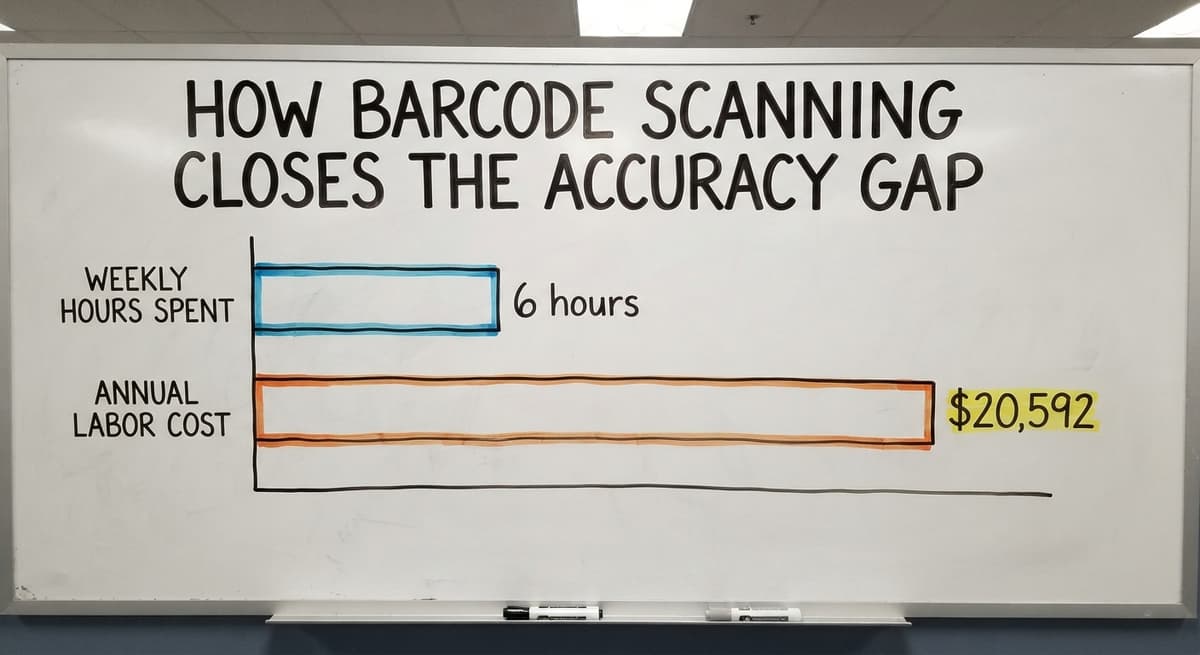
A small distributor running 3 staff on inventory matching, each spending 6 hours a week at the current median wage for stock clerks, spends roughly $20,592 a year on that single task alone, according to wage data from the US Bureau of Labor Statistics. Real-time tracking does not eliminate that role, but it redirects those hours from counting to fulfilling.
FAQ: Why does accurate stock tracking matter for a small distributor or warehouse?
Inaccurate counts cause delayed orders, wasted labor, and customer churn. For a small operation, one wrong count on a fast-moving SKU can mean a missed sale and an emergency reorder at a higher price. Real-time tracking removes the manual update step that creates most of those errors.
How Does Inventory Management Prevent Stockouts and Overstock?
Inventory management prevents stockouts and overstock by setting reorder points, which are the minimum quantity levels that trigger a new buy order before stock runs out. A stockout means a missed sale and a disappointed customer. Overstock ties up cash and occupies shelf space that could hold faster-moving product.
For a warehouse manager juggling 200 or more SKUs, knowing exactly when to reorder each one is not realistic without a system. Reorder points do that math automatically. The system watches each SKU and flags a buy when stock drops to the threshold, not when someone notices the shelf is empty.
The US Federal Trade Commission's Mail and Telephone Order Rule needs sellers to ship within the time they promise or notify the customer of a delay. Accurate reorder points are what make that promise possible to keep.
The Real Cost of Getting It Wrong
Overstock and stockouts hurt in different ways:
- A stockout on a top-selling SKU sends the customer to a competitor, and some never come back.
- Overstock on a slow mover can mean markdowns, expiration losses, or disposal costs.
- Buying in a panic to cover a stockout often means paying a premium price or expedited freight.
- Excess stock that sits past its shelf life becomes a write-off that hits the bottom line directly.
Reorder points, combined with accurate demand data, let a fulfillment center manager stay ahead of both problems at once.
The comparison is easier when one option is built for you
Off-the-shelf means fitting your process to the software. We do it the other way round, and the first look costs nothing.
Book a callTracking the Movement of Goods
Every time product moves, that event should create a record. Inventory management logs each step: received from a supplier, picked for an order, shipped to a customer, returned by a buyer. That movement history is what supports accurate invoicing, smart purchasing, and loss prevention.
Without a connected system, movement data lives in email threads, sticky notes, and someone's memory. When a question comes up about a shipment or a return, staff spend time reconstructing what happened instead of moving the next order.
How a Single Source of Truth Supports Growth
A connected inventory system replaces those manual handoffs with a timestamped record that anyone on the team can pull up in seconds. That single source of truth is what makes a warehouse run faster as it grows, rather than slower.
FAQ: How does tracking product movement help with loss prevention?
Every recorded movement creates an audit trail. When expected counts do not match actual counts, the movement log shows where the gap appeared. That makes it possible to identify whether the loss happened at receiving, in storage, or during picking, and to fix the process rather than just write off the loss.

Supporting Accurate Order Fulfillment
Fulfilling orders correctly and on time is the visible result of good inventory management. Customers see the result of every inventory decision, even if they never think about the system behind it.
When inventory data is accurate, pick-and-pack errors drop and shipping speed improves. An operations manager who is accountable for order accuracy every day knows what a single wrong item in a box costs: a return label, a replacement shipment, a customer credit, and the labor to handle all three. Those costs add up fast across a high-volume fulfillment center.
Accurate inventory data means pickers go to the right location and find the right product. It means the system does not confirm an order it cannot fill. It means the shipping team is not chasing down discrepancies at the end of a shift.
What Good Fulfillment Looks Like in Practice
An operation with reliable inventory tracking can expect:
- Fewer "where is my order" calls because shipments go out on time.
- Lower return rates because the right item ships the first time.
- Faster onboarding for new warehouse staff because the system guides the pick, not institutional memory.
- Cleaner carrier manifests because weights and quantities are pulled from live data.
Order fulfillment accuracy is not a warehouse metric in isolation. It is the number a customer feels directly.
See it running on your own process first
No build cost. The subscription starts once it is live and doing the job, not before.
Book a callConnecting Inventory Data to Financial Records
Inventory value sits on the balance sheet, so accurate counts feed directly into financial reporting. The IRS is explicit about this. IRS Publication 538 states: "To figure taxable income, you must value your inventory at the beginning and end of each tax year." That is a legal requirement, not a best practice.
Many small distributors manage their finances in their accounting software but track stock separately in spreadsheets. Those two pictures rarely match by month-end, which means the financial statements are built on guesswork.
How Custom Inventory Software Works Alongside Your Accounting Package
Good inventory management keeps the two aligned without requiring a full ERP replacement. Custom inventory software can sit alongside your accounting package, pushing accurate cost-of-goods data into it automatically. The finance team gets clean numbers. The warehouse team keeps the workflow they already know. Neither group has to learn a new system from scratch.
For any distributor wondering how custom working software works alongside their accounting package, the short answer is that it handles the warehouse side and hands off the financial data, rather than replacing the tool your bookkeeper already uses.
FAQ: How does inventory management connect to financial records in your accounting software?
Inventory value is a balance-sheet item. When stock counts are wrong, cost-of-goods figures are wrong, and so is taxable income. A system that updates your accounting software automatically as product moves keeps the financial picture current without a manual matching step at month-end.

Reducing Waste and Shrinkage
Shrinkage is the gap between what you expect to have and what you actually have. It covers theft, damage, expiration, and recording errors. For a distributor handling perishable goods or high-value product lines, shrinkage can quietly erase margin without anyone noticing until a physical count reveals the problem.
Inventory management surfaces shrinkage by comparing expected counts to actual counts on a regular cycle. Cycle counting, where staff count a portion of the warehouse each week rather than shutting down for a full annual count, catches small losses before they compound.
The NIST Manufacturing Extension Partnership highlights regular inventory review as a core supply chain practice precisely because small, consistent losses are harder to spot than large, sudden ones. A system that flags variances automatically gives managers a chance to investigate while the trail is still fresh.
What Are the Signs That Manual Inventory Tracking Has Stopped Working?
Spreadsheets and printed sheets work at very small scale. As order volume grows, the manual approach starts to crack, and the signs are hard to miss. This is a natural growth stage, not a failure. Every successful distributor hits this point eventually.
Watch for these signals:
- Frequent stockouts on SKUs you thought were well-stocked, because the spreadsheet was not updated after the last pick.
- Inventory counts that never match the system, no matter how carefully staff enter data.
- Hours spent reconciling at month-end instead of processing orders.
- Staff making judgment calls about stock levels because they do not trust the numbers in the system.
- Order errors rising as volume grows and the manual process cannot keep pace.
Not sure this is the right shape for your operation
Describe how the work runs today. We map it on a call and show you what it would look like built around that, before you spend anything.
Book a callThe Hidden Labor Cost of Spreadsheet-Based Inventory
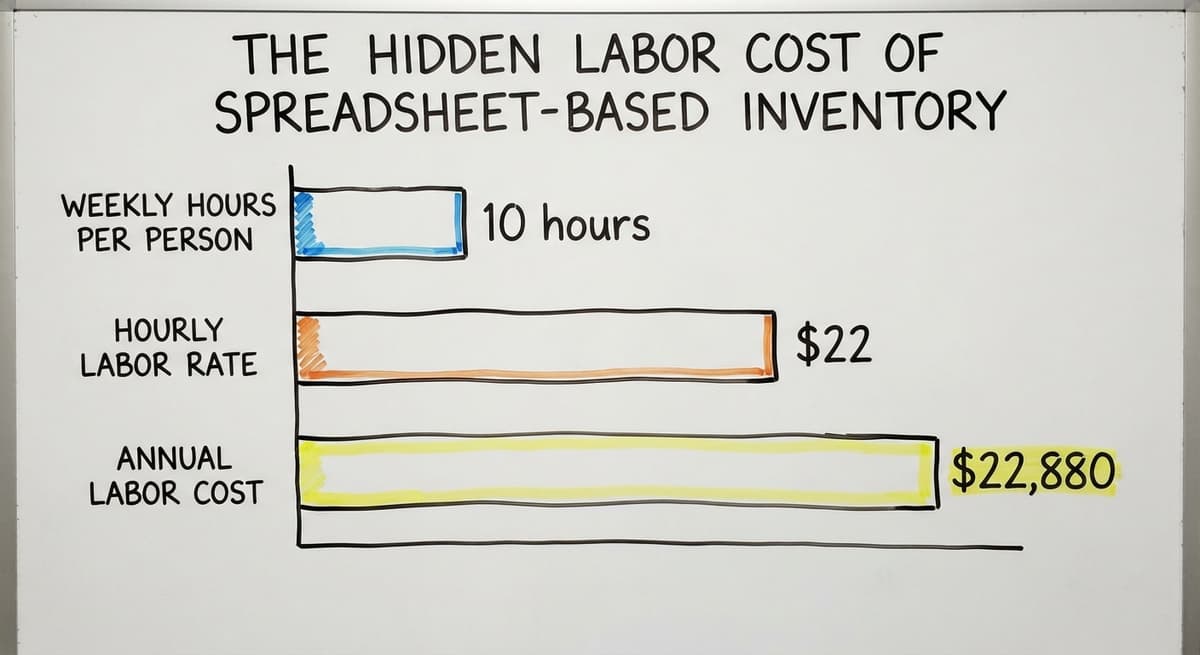
If 2 people are spending 10 hours each per week reconciling inventory data at $22 an hour, that is $22,880 a year in labor that a connected system could redirect to productive work. The spreadsheet feels free, but the labor cost of maintaining it is not.
Replacing spreadsheets with custom software does not have to mean a six-month rollout project. The right approach replaces only the parts that cause the most pain, without disrupting what already works.

How Does Custom Inventory Software Differ From a Large ERP System?
Custom inventory software is built around how your business already works, not the other way around. Off-the-shelf platforms and large ERP systems often need an operation to reshape its workflow to match the software's logic. That means retraining staff, rebuilding processes, and absorbing months of disruption before seeing any benefit.
Inventory management software for wholesale distributors that is purpose-built for your operation does the opposite. It maps to your receiving process, your pick paths, your SKU structure, and your existing tools. It sits alongside your accounting software rather than replacing it. It handles the manual steps that create the most errors and leaves the rest alone.
Why a Local Support Team Changes the Equation
A local team that builds and supports the system can make changes quickly. When a supplier changes a label format or a new product line needs a different tracking method, the fix happens in days, not quarters.
Warehouse management software for small and mid-size operations does not need to carry every feature a Fortune 500 distributor uses. It needs to solve the specific problems slowing your team down today.
FAQ: What does inventory shrinkage mean and how does a management system reduce it?
Shrinkage is the difference between recorded stock and actual stock. It comes from theft, damage, expiration, or data entry errors. A management system reduces shrinkage by logging every movement and flagging variances between expected and actual counts, so losses are caught early rather than discovered at year-end.
Putting It All Together
The main function of inventory management is not a single task. It is a set of daily functions that either work together or create cascading problems. Accurate counts feed clean fulfillment. Clean fulfillment supports reliable financial reporting. Reliable reporting lets you buy smarter and carry less dead stock.
When to Act on a Purpose-Built Inventory System
For a wholesale distributor or warehouse operator running on spreadsheets, the question is not whether to build a better system. It is how to do it without disrupting the operation you have already built.
Custom workflow rollout, shaped around your real processes and connected to the tools you already use, is how growing distributors close the gap between where they are and where they need to be. If your counts are drifting, your staff are reconciling instead of shipping, and your accounting software numbers do not match the warehouse floor, that is the moment to act.
Reach out to discuss what a purpose-built inventory system would look like for your operation. No ERP migration required.
Frequently asked questions
Why does accurate stock tracking matter for a small distributor or warehouse?
Inaccurate counts cause delayed orders, wasted labor, and customer churn. For a small operation, one wrong count on a fast-moving SKU can mean a missed sale and an emergency reorder at a higher price. Real-time tracking removes the manual update step that creates most of those errors.
How does tracking product movement help with loss prevention?
Every recorded movement creates an audit trail. When expected counts do not match actual counts, the movement log shows where the gap appeared. That makes it possible to identify whether the loss happened at receiving, in storage, or during picking, and to fix the process rather than just write off the loss.
How does inventory management connect to financial records in your accounting software?
Inventory value is a balance-sheet item. When stock counts are wrong, cost-of-goods figures are wrong, and so is taxable income. A system that updates your accounting software automatically as product moves keeps the financial picture current without a manual matching step at month-end.
What does inventory shrinkage mean and how does a management system reduce it?
Shrinkage is the difference between recorded stock and actual stock. It comes from theft, damage, expiration, or data entry errors. A management system reduces shrinkage by logging every movement and flagging variances between expected and actual counts, so losses are caught early rather than discovered at year-end.
What is the difference between a stockout and overstock, and why does each hurt the business?
A stockout means you have no product to fill an order, which loses the sale and can push the customer to a competitor. Overstock means you bought too much, tying up cash in product that sits on the shelf instead of turning into revenue. Reorder points set in your inventory system help prevent both by triggering buys at the right time.
What are the signs that manual inventory tracking has stopped working?
The clearest signs are frequent stockouts on items you thought were stocked, inventory counts that never match the system, and staff spending hours reconciling data instead of processing orders. If your team is making judgment calls about stock levels because they do not trust the numbers, the manual process has already broken down.
How does custom inventory software differ from a large ERP system?
A large enterprise resource planning system usually needs the business to reshape its processes to match the software. Custom inventory software is built around how your operation already works. It handles the specific tasks causing the most errors, connects to your accounting package without replacing it, and can be updated quickly when your needs change.
What is the main function of inventory management for a wholesale distributor?
The main function is to ensure the right products are available in the right quantity at the right time, without tying up more cash than necessary in excess stock. For a wholesale distributor, that means accurate counts, timely reorders, clean order fulfillment, and financial data that matches what is actually on the warehouse floor.
Start with a free first look
A 30 minute call, your operation mapped, and a clear picture of what we would build. No obligation and nothing to install.
Book a callRelated guides
The rest of this guide, for the parts of the job this page does not cover.
- What is the Main Purpose of Inventory Management
- What Are the 5 Benefits of Inventory Management?
- What Are the 5 Main Activities in a Warehouse?
- What is the Difference Between Aggregate and Item Inventory Management
- What is an Important Factor in Inventory Management
- What is Abc Classification in Inventory Management
- What is Inventory Management in Working Capital
- What is Inventory Management and Its Types
- What is Information Technology Inventory Management
- What is Risk Pooling in Inventory Management
- What is Inventory Listing
- What is Inventory Management Mary Kay
- What is Stock Taking in Inventory Management
- What is Bin Number in Inventory Management
- What is Inventory
- What is the Goal of Inventory Management Quizlet
- What is the Implication of Proper Inventory Management
- What is Omni-channel Inventory Management
- What is Inventory Management and Its Importance
- What is the Importance of Eoq in Inventory Management
- What is the Importance of Quality Inventory Management
- What is Inventory Management Explain Techniques of Inventory Management
- What is Mean by Inventory Management
- What is Inventory Management Meaning in Hindi