


What Is Epq In Inventory Management
EPQ stands for Economic Production Quantity. It is the batch size that keeps your total production and storage costs as low as possible. If your team makes, kits, or assembles products in-house, EPQ tells you how many units to run at one time. This guide covers the formula, the inputs, and when EPQ fits your operation. Reviewed October 2026.
Book a callEPQ Defined in Inventory Management
Economic Production Quantity is the ideal size of a production run. Run too many units at once and storage costs climb. Run too few and you pay setup costs over and over. EPQ finds the number in between where total cost is lowest.
EPQ applies when your business produces or assembles goods in batches. That covers a fulfillment center that kits orders, a wholesale distributor that repackages bulk goods, or a light manufacturer building to stock. It does not apply when you simply buy finished goods and ship them as received. In that case, a different model fits better.
The goal is simple: spend less on setup and storage combined, without running out of stock.
We build it for your operation, and the first look is free
If you would rather not compare products, describe how your operation already works and we build the system around it.
No build cost. You see it running on your own process first, and the monthly subscription starts only once it is live.
Book a callHow EPQ Differs from EOQ in Inventory Management
EOQ, or Economic Order Quantity, assumes you receive a full order all at once from a supplier. You place the order, the pallet arrives, and inventory jumps up in one step.
EPQ works differently. Inventory builds gradually while a production run is still in progress. Units are being made and used at the same time. That overlap changes the math.
GS1, the global body that sets barcode and supply chain standards, notes that traceability depends on knowing exactly "what" and "how many" move through each step. As GS1 states at gs1.org, accurate unit-level data underpins every count in the chain. That principle applies whether you are counting received orders or counting units coming off a production line.
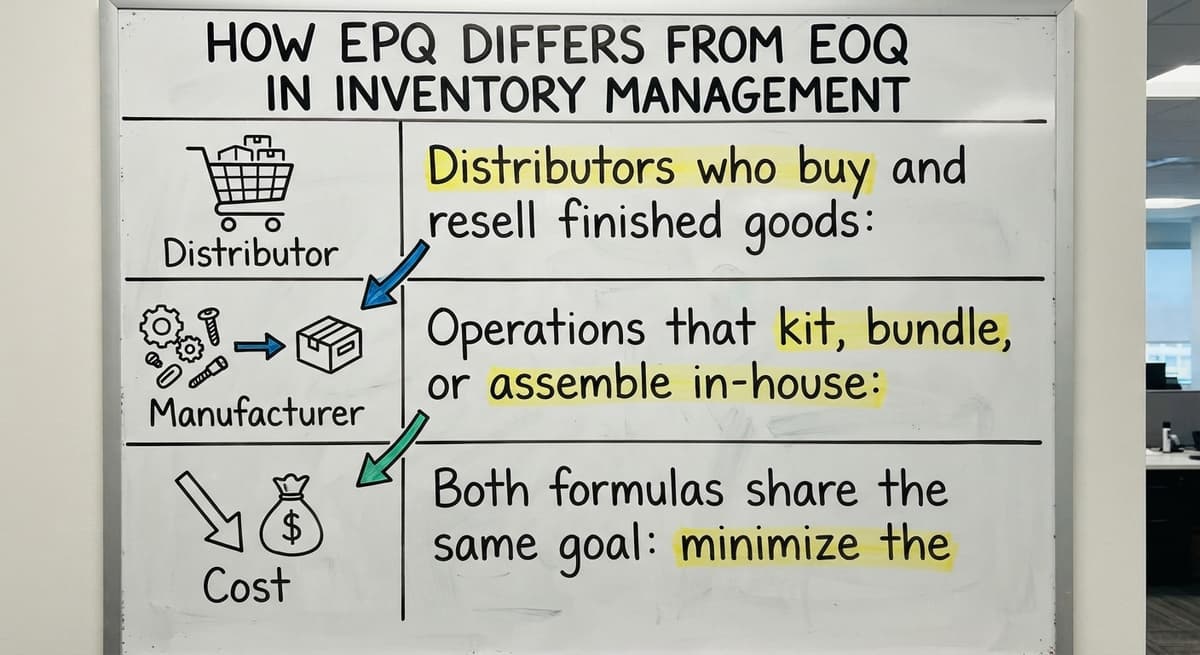
- Distributors who buy and resell finished goods: use EOQ.
- Operations that kit, bundle, or assemble in-house: use EPQ.
- Both formulas share the same goal: minimize the combined cost of setup and holding.
The right model depends on where your inventory comes from, not just how much you carry.
What Is the EPQ Formula and What Inputs Does It Need?
The EPQ formula is: EPQ = square root of (2 × Annual Demand × Setup Cost) divided by (Holding Cost per Unit × (1 minus Demand Rate divided by Production Rate)).
The term at the bottom, often written as (1 - d/p), is what separates EPQ from EOQ. It accounts for the fact that inventory is being consumed while it is still being built. If your line produces 500 units a day and demand pulls 100 units a day, stock never reaches the level it would if all 500 arrived at once.
You need 4 inputs:
- Annual demand in units
- Setup or changeover cost per run
- Holding cost per unit per year
- Production rate in units per day or week
Keep the formula in a spreadsheet or inside your inventory software. The concept matters more than memorizing the equation.
The comparison is easier when one option is built for you
Off-the-shelf means fitting your process to the software. We do it the other way round, and the first look costs nothing.
Book a callWhat Each Input Means for Your Operation
Accurate inputs produce a useful EPQ. Guessed inputs produce a number that looks precise but points you in the wrong direction.
Annual demand is how many units you expect to sell or ship in a year. Use actual sales history, not a rough estimate. Seasonal products need extra care: a single annual average can mask months where demand doubles.
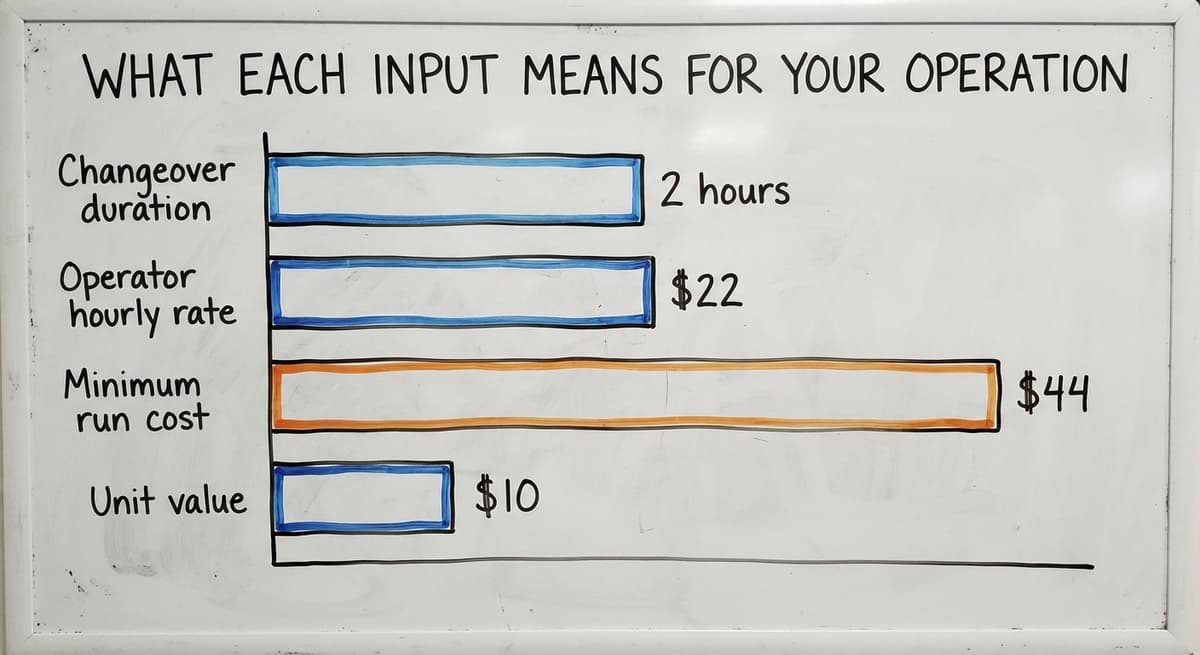
Setup cost covers labor, downtime, and materials spent preparing each production run. If a changeover takes 2 hours and your operator earns $22 an hour, that run costs at least $44 before a single unit is made. According to the US Bureau of Labor Statistics, the median wage for stock clerks and order fillers is in that range, making labor the largest piece of most setup costs. See current wage data at bls.gov.
Holding cost covers storage space, insurance, spoilage risk, and capital tied up in unsold stock. A common starting estimate is 20 to 30 percent of unit value per year. A unit worth $10 costs roughly $2 to $3 a year to hold.
Production rate is how many units your line or team completes per day or week. Measure it; do not guess.
When EPQ Actually Helps a Warehouse or Distributor
EPQ is most useful when setup costs are real and holding costs add up fast. If switching from one SKU to another takes your team an hour, that cost belongs in the formula.

Good fits for EPQ:
- A fulfillment center that kits or bundles products before shipping, where each kit run needs a line changeover.
- A wholesale distributor that repackages bulk goods into retail units, where each run uses labor and packaging materials.
- Any operation where batch size directly affects how often the line stops and restarts.
Poor fits for EPQ:
- A pure reseller who receives finished goods and ships them as-is. Reorder-point logic or EOQ fits that model better.
- An operation with near-zero setup cost, where running smaller batches more often costs nothing extra.
The US Census Bureau tracks inventories-to-sales ratios for wholesale firms at census.gov. When that ratio climbs, holding costs are rising across the sector, which makes the EPQ calculation more valuable, not less.
If your operation sits between pure reselling and full production, EPQ can still guide how large a batch to run before switching SKUs.
Common Mistakes When Applying EPQ
The formula is straightforward. The mistakes happen before you open the spreadsheet.
- Using stale demand figures. Annual averages hide seasonal swings. A product that sells 1,000 units in December and 100 in July needs a different approach than a flat 550 per month.
- Ignoring real setup costs. If changeover takes 2 hours of labor plus 30 minutes of downtime, both belong in the number. Undercount setup cost and EPQ tells you to run smaller batches than you should.
- Treating holding cost as just shelf space. Spoilage, obsolescence, and capital cost all count. The IRS needs you to value inventory at the start and end of each tax year. As IRS Publication 538 states, "To figure taxable income, you must value your inventory at the beginning and end of each tax year," which means carrying too much stock has a direct tax-year consequence. See the full guidance at irs.gov.
- Setting EPQ once and leaving it. Demand shifts. Recalculate when a product line changes or when a season ends.
- Running EPQ without connecting it to your production schedule. A number on a spreadsheet does nothing if the floor team does not know when to start the next run.
See it running on your own process first
No build cost. The subscription starts once it is live and doing the job, not before.
Book a callEPQ and Your Inventory Software
EPQ is only useful when the inputs live somewhere accurate and current. Many small distributors track demand in one place, setup costs in another, and holding costs nowhere at all. That fragmentation makes the formula hard to apply with any confidence.

Inventory management software that connects demand history, production schedules, and cost data lets you run EPQ calculations without rebuilding a spreadsheet each quarter. The NIST Manufacturing Extension Partnership offers vendor-neutral guidance on building supply chain processes that support this kind of data flow, available at nist.gov.
The goal is not to do the math by hand every few months. The goal is a system that flags when your batch sizes are drifting out of range, so you catch the problem before holding costs climb or a run is too short to cover setup.
Inventory software for wholesale distributors that integrates with an accounting package can pull cost data automatically, keeping inputs fresh without extra manual work. Replacing Excel-based inventory tracking with custom software removes the version-control problem that makes stale inputs so common.
Fitting EPQ Into a Practical Reorder System
EPQ answers one question: how many units should one production run produce? It does not answer when to start the next run.
Pair EPQ with a reorder point, which is the stock level that triggers a new run. If your reorder point is 200 units and your EPQ is 800, you start a new run when stock drops to 200 and you produce 800 units. How reorder points work in a warehouse connects directly to this: the reorder point keeps you from hitting zero while a run is still in progress.
Safety stock sits above the reorder point as a buffer. It covers demand spikes and production delays. A simple way to size it: multiply your average daily demand by the number of days a delayed run would take to recover.
For example, if daily demand is 50 units and a delayed run adds 3 days, safety stock of 150 units covers that gap. Three inputs, one coherent system:
- EPQ sets the batch size.
- Reorder point sets the trigger.
- Safety stock sets the cushion.
Together they answer how much to make, when to start, and how much buffer to keep.
Is EPQ the Right Model for Your Business?
EPQ is worth using if you produce, kit, bundle, or assemble in batches and setup time is a real cost. If you buy finished goods and resell them without any production step, EOQ or a simple reorder-point system is usually enough.
The best test is practical. Pick 1 SKU. Track it for a quarter using EPQ batch sizes. Compare your total setup cost plus holding cost to what you spent in the prior quarter. The difference tells you whether the model fits your operation or whether a simpler approach works just as well.
Custom inventory software for small and mid-size distributors can automate that comparison. Instead of a manual quarterly review, the system flags SKUs where actual batch sizes have drifted from the EPQ target, so you act on real data rather than a scheduled reminder.
Accounting software integration for warehouse operations means cost data from your accounting package feeds the EPQ inputs directly, keeping the formula grounded in current numbers rather than last year's estimates.
If setup and holding costs are real in your operation, EPQ is not an academic exercise. It is a practical tool that pays for itself the first time it stops you from overproducing a slow-moving SKU.
Frequently asked questions
What is EOQ analysis in inventory management?
EOQ analysis finds the order quantity that minimizes the combined cost of ordering and holding inventory. You order from a supplier, receive the full shipment at once, and EOQ tells you how many units to order each time. It is the right model when you buy finished goods rather than produce them. EPQ is the related model for operations that make or assemble goods in batches.
How to tune inventory management?
There is no single answer because the right approach depends on your operation. A pure reseller benefits most from accurate reorder points and demand forecasting. A kitter or assembler gains more from EPQ batch sizing paired with safety stock. Across all types, the consistent wins come from accurate data, regular recalculation as demand shifts, and a system that connects cost data to ordering or production decisions automatically.
Are roq and EOQ the same?
ROQ stands for Replenishment Order Quantity, which is a general term for the quantity ordered or produced in a single cycle. EOQ is a specific formula that calculates the optimal replenishment quantity based on ordering cost and holding cost. They describe the same concept at different levels of precision: ROQ is the category, EOQ is one method for calculating it.
What is another name for EOQ?
EOQ is sometimes called the Wilson formula, after the researcher who formalized it in the early twentieth century. You may also see it referred to as the optimal order quantity or the minimum-cost order quantity. All of these names describe the same calculation: the order size that minimizes combined ordering and holding costs.
What does EPQ stand for in inventory management?
EPQ stands for Economic Production Quantity. It is the batch size that minimizes the combined cost of setting up a production run and holding the finished units in stock. It applies when your business makes, kits, or assembles goods rather than buying them ready to ship.
Is EPQ relevant for a business that kits or bundles products?
Yes. Kitting and bundling involve a setup step each time you start a new batch, which is exactly what EPQ accounts for. If switching from one bundle setup to another costs labor time and materials, that cost belongs in the EPQ formula. The result tells you how large each kitting run should be before you switch to the next SKU.
How does EPQ connect to reorder points and safety stock?
EPQ tells you how many units to produce in one run. A reorder point tells you when to start that run, specifically the stock level at which you trigger production. Safety stock sits above the reorder point as a buffer for demand spikes or delays. The three work together: EPQ sets the batch size, the reorder point sets the trigger, and safety stock sets the cushion.
Start with a free first look
A 30 minute call, your operation mapped, and a clear picture of what we would build. No obligation and nothing to install.
Book a callRelated guides
The rest of this guide, for the parts of the job this page does not cover.
- What is the Difference Between Aggregate and Item Inventory Management
- What is Jit Inventory Management
- What is Kanban System of Inventory Management
- What is the Definition of Inventory Management
- What is an Important Factor in Inventory Management
- What is Abc Classification in Inventory Management
- What is Inventory Management in Working Capital
- What is Poor Inventory Management
- What is Inventory Management and Its Types
- What is the Main Purpose of Inventory Management
- What is Inventory Management in Pharmacy
- What is Effective Inventory Management
- What is Information Technology Inventory Management
- What is Risk Pooling in Inventory Management
- What is Inventory Management Mary Kay
- What is Stock Taking in Inventory Management
- What is Hospital Inventory Management
- What is Bin Number in Inventory Management
- What is the Scope of Inventory Management
- What is the Goal of Inventory Management Quizlet
- What is the Implication of Proper Inventory Management
- What is Omni-channel Inventory Management
- What is Inventory Management and Its Importance
- What is the Importance of Eoq in Inventory Management