


What Is The Golden Rule For Inventory?
Reviewed and updated: October 2026
The golden rule for inventory is simple: never hold more stock than you can sell before it costs more to store than it earns. Stock too little and you lose sales. Stock too much and you drain cash. The rule keeps those two outcomes in balance. Every inventory decision, from setting a reorder point to choosing a safety stock level, flows from this one idea.
Book a callThe Golden Rule for Inventory in Plain Terms
The golden rule for inventory comes down to one trade-off. Cash sitting in a warehouse shelf is cash that cannot do anything else. Your goal is to have enough product to fill every order that comes in, and not one unit more than that.
Think of it as a dial. Turn it too far toward "always have stock" and you tie up cash in product that sits. Turn it too far toward "keep it lean" and customers wait, or walk. The golden rule keeps that dial in the right position. It is not a formula. It is a discipline. And it applies whether you run 50 SKUs or 5,000.
We build it for your operation, and the first look is free
If you would rather not compare products, describe how your operation already works and we build the system around it.
No build cost. You see it running on your own process first, and the monthly subscription starts only once it is live.
Book a callWhy This Rule Matters for Wholesale Distributors
Wholesale and distribution businesses carry high SKU counts and thin margins. Overstock is not just an inconvenience. It is a direct cost.
Cash locked in slow-moving product cannot pay your warehouse staff, cover your lease, or fund a faster-moving line. That is the real pain. You may have product worth $200,000 on your shelves while struggling to make payroll, because the cash is frozen in boxes that are not moving.
Accurate tracking is the foundation of fixing that. As GS1 notes, barcode standards exist to give every product a unique, scannable identity so that counts stay reliable across the supply chain. You can read more about those standards at gs1.org/standards/barcodes. Without that kind of reliable spotting, your inventory data drifts, and the golden rule becomes impossible to apply with any consistency.
Bad data is what turns a manageable overstock into a cash crisis.
Stock Enough to Serve Customers, Not So Much That It Hurts Cash Flow?
How do you stock enough to serve customers without hurting cash flow? You set a reorder point, which is the quantity at which you place a new order before you run out.

Inventory has 2 failure modes. A stockout happens when you run out and cannot fill an order. Overstock happens when you buy more than demand can absorb. Both cost money. Stockouts cost you the sale and sometimes the customer. Overstock costs you carrying fees, storage space, and tied-up cash.
A reorder point is the practical tool that keeps you out of both traps. It tells you exactly when to order, based on how fast you sell and how long your supplier takes to deliver. Safety stock is a small buffer you add on top of that point to absorb unexpected demand spikes. Setting both correctly is how the golden rule becomes a daily habit rather than a quarterly worry.
What Is a Reorder Point and How Do You Set One?
A reorder point is calculated from 2 numbers: your average daily sales for a SKU and your supplier's lead time in days. Multiply them together and you have the quantity at which a new order should go out. If you sell 10 units a day and your supplier takes 5 days to deliver, your reorder point is 50 units.
Safety stock sits on top of that. It covers the gap when a shipment is late or demand jumps. A small buffer, even 10 to 20 percent of your reorder quantity, can prevent a stockout without adding much carrying cost.
The Role of Accurate Inventory Data
The golden rule only works when your numbers are right. A reorder point set on bad data triggers orders at the wrong time. You end up with overstock on one SKU and a stockout on another, often in the same week.

The most common problem in small distribution operations is that counts live in spreadsheets, printed pick sheets, or one person's memory. That person goes on vacation and the system goes with them. Inventory data that depends on a single person is not a system, it is a risk.
Real-time visibility means every receipt, every pick, and every return updates the count the moment it happens. The IRS needs accurate inventory valuation for tax purposes. As IRS Publication 538 states, "To figure taxable income, you must value your inventory at the beginning and end of each tax year," per irs.gov/publications/p538. That legal obligation alone is reason enough to get the data right. Working accuracy is the benefit on top of compliance.
The comparison is easier when one option is built for you
Off-the-shelf means fitting your process to the software. We do it the other way round, and the first look costs nothing.
Book a callWhy Spreadsheets Fail as an Inventory System
Spreadsheets are built for analysis, not for live transaction tracking. Every time someone forgets to update a row, the count drifts. By the end of a busy week, the sheet may be off by dozens of units across multiple SKUs. Those errors compound. A count that is wrong by 5 percent today is wrong by 15 percent next month if no one catches it.
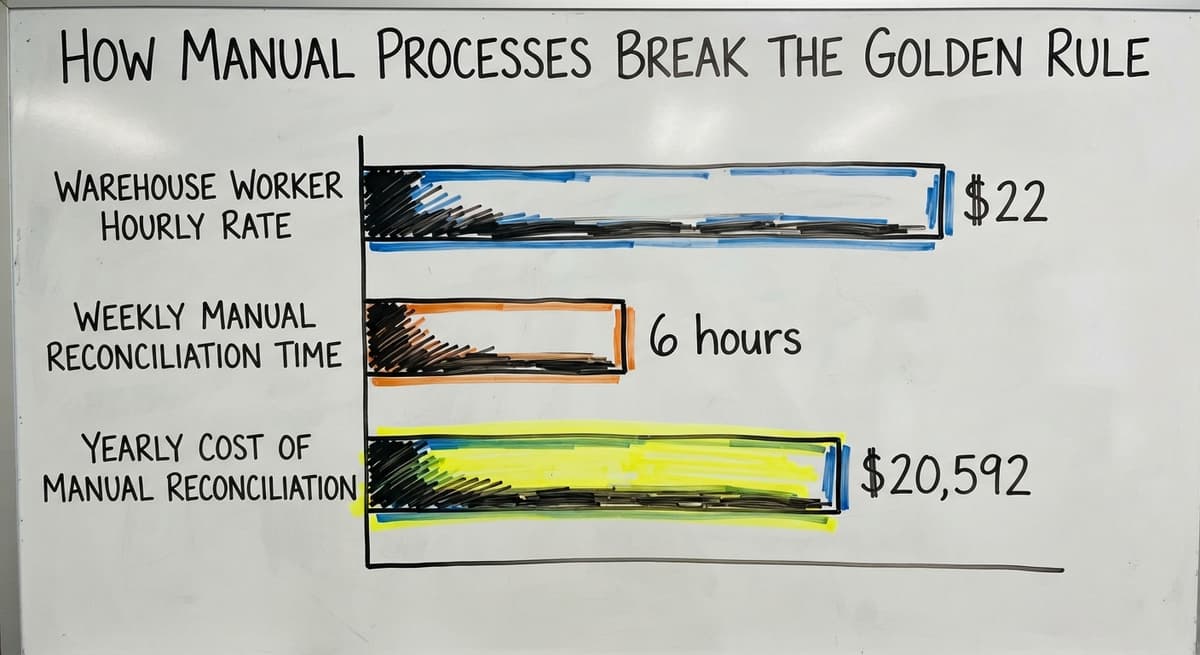
How Manual Processes Break the Golden Rule
Picture a warehouse manager who updates a spreadsheet after every inbound shipment. On a slow Tuesday, that works fine. Then a large order comes in, 3 trucks arrive at once, and the phone rings with a customer question. The spreadsheet update gets pushed to the end of the day. Then to the next morning. Then it gets skipped.

By Thursday, the count is off. The system shows 80 units of a fast-moving SKU. The shelf has 40. A sales rep, trusting the system, commits to a customer order that cannot be filled. Or the manager, seeing 80 units, skips the reorder. Stock runs out before the next delivery.
This is not a failure of the manager. It is a failure of the process. Manual updates have a lag, and that lag grows during the exact moments when accuracy matters most. The US Bureau of Labor Statistics shows that warehouse workers earn a median around $22 per hour, per bls.gov. 3 people spending 6 hours a week on manual count matching costs about $20,592 a year, and still leaves the data unreliable.
Applying the Golden Rule Without Replacing Your Accounting Package
Many small distributors run their financials in a entry-level accounting package and have no interest in replacing it with a full ERP system. That is a reasonable position. A full ERP migration is expensive, disruptive, and often overkill for an operation with 5 to 50 staff.

The golden rule does not need a new financial system. It needs accurate, timely inventory data feeding into whatever system you already use. An inventory layer that sits between your warehouse floor and your accounting package can close the data gap without forcing a migration.
Custom working software built around an existing entry-level accounting package is one path that works well for this profile. The warehouse team works in a system built around their actual process. The financial team keeps working in the tool they know. Data flows between them automatically, so the count is always current. The goal is not to replace what works. It is to fill the gap that manual processes leave open.
The NIST Manufacturing Extension Partnership offers vendor-neutral guidance on exactly this kind of supply chain process improvement, at nist.gov/mep/supply-chain, and consistently points to data accuracy as the first lever to pull.
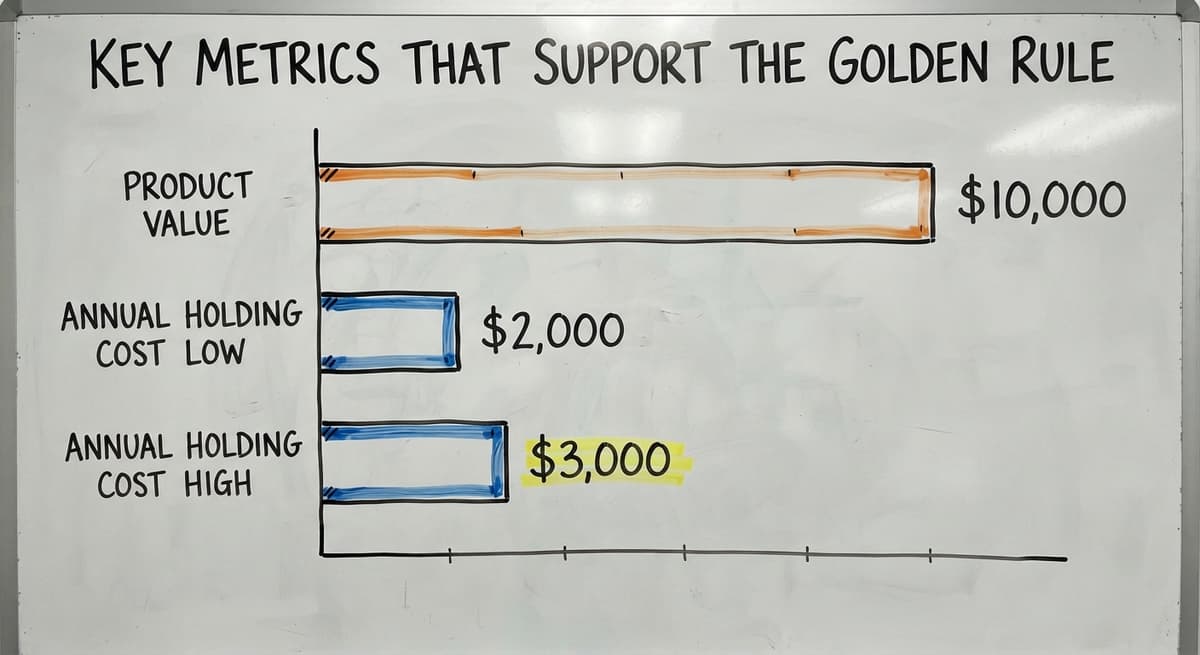
Key Metrics That Support the Golden Rule
Three numbers tell you whether you are following the golden rule or drifting from it. Tracking them regularly turns the rule from a principle into a measurable standard.
- Inventory turnover ratio tells you how many times your total stock cycles through in a given period. A higher number means product moves quickly. A low number means cash is sitting. Calculate it by dividing your cost of goods sold by your average inventory value.
- Days on hand tells you how long your current stock would last at your current sales rate. Divide your on-hand quantity by your average daily sales. If that number is climbing, you are building overstock.
- Carrying cost percentage is what it costs you to hold inventory, expressed as a share of its value. Storage, insurance, and spoilage all count. Most operations run between 20 and 30 percent annually, meaning a product worth $10,000 costs $2,000 to $3,000 a year just to hold.
The US Census Bureau tracks inventories-to-sales ratios for wholesale firms nationally, at census.gov/wholesale, which gives you a benchmark for your sector. If your days on hand is far above your sector average, overstock is costing you more than you realize.
See it running on your own process first
No build cost. The subscription starts once it is live and doing the job, not before.
Book a callInventory Turnover as a Warning Signal
A falling turnover ratio is an early warning that the golden rule is slipping. It means you are buying faster than you are selling, or selling slower than you planned. Catching that signal early, before a cash crunch, is the whole point of tracking it regularly.
Set a target turnover for each product category based on your lead times and margin. Review it monthly. When a category drops below its target, investigate before you reorder.
Putting the Golden Rule Into Practice at Your Operation
Start with an honest look at your current stock. Pull a report sorted by days on hand. The SKUs at the top of that list, the ones with 180 or 300 days of supply on the shelf, are where cash is frozen. The SKUs with 5 or 10 days of supply are where stockouts are coming.
Next, set reorder points for your top 20 SKUs based on real lead times and actual sales velocity, not what you think they are. Pull the last 90 days of sales data and do the math. That alone will change several of your reorder triggers.
Then build a process that flags when stock crosses those thresholds. It does not have to be sophisticated. Even a simple alert, whether from a spreadsheet formula or a purpose-built tool, is better than waiting until a shelf is empty.
The FTC's mail and telephone order rule needs merchants to ship when promised, per ftc.gov. Stockouts put you at legal risk, not just commercial risk. Inventory management software for wholesale distributors built around your actual SKU mix and lead times makes this kind of threshold tracking automatic rather than manual.
Building a Reorder Discipline That Sticks
The hardest part of applying the golden rule is consistency. It is easy to set reorder points in January and ignore them by March. Build a weekly review into your operations rhythm. Fifteen minutes, same time every week, looking at the same 3 metrics. That habit is worth more than any software feature.
When you find a SKU that keeps triggering the wrong behavior, ask why. Is the lead time wrong? Has demand shifted? The golden rule is not a set-and-forget system. It is a feedback loop.
When Does a Custom Inventory System Make the Golden Rule Easier to Keep?
A custom system makes the most difference when your team is already doing the right things but the tools are slowing them down. If you have 5 to 100 staff, run your financials in an accounting package, and track inventory in a spreadsheet or an old database, the gap between your process and your data is probably costing you more than you think.
Replacing Excel and Access databases with purpose-built software removes the manual lag that causes most rule violations. You do not need a six-figure ERP project to get there. A system built around your existing workflows, one that feeds your accounting package rather than replacing it, can close the data gap in weeks rather than months.
Warehouse management for small and mid-size operations works best when the software fits the operation, not the other way around. If the tool your team is supposed to use slows them down, they will stop using it, and the data gap returns.
If that description fits your operation, a conversation about what a purpose-built inventory layer could look like for your specific workflow is a practical next step, not a commitment to a long rollout.
The Bottom Line on the Golden Rule for Inventory
The golden rule for inventory is not complicated. Hold what you can sell. Do not hold what you cannot. The discipline is in applying it every day, with numbers you can trust.
Set reorder points on real data. Track turnover and days on hand weekly. Build a process that flags problems before they become stockouts or cash crunches. And make sure your inventory data feeds your financial system automatically, so the two never drift apart.
Small operations can do this. You do not need a massive system. You need accurate data, a few key metrics, and a process that runs without depending on one person's memory. Start with your worst 5 SKUs and apply the rule there first. The habit will follow.
Frequently asked questions
What is the golden rule for inventory management?
The golden rule for inventory is: never hold more stock than you can sell before the cost of storing it exceeds what it earns. It keeps you from running out of product and from tying up cash in stock that sits on the shelf.
Why is the golden rule especially important for wholesale distributors?
Wholesale distributors operate on thin margins and carry large SKU counts. Cash locked in slow-moving inventory cannot cover payroll, operating costs, or faster-moving product lines. The golden rule keeps cash working instead of sitting.
What is a reorder point and how does it relate to the golden rule?
A reorder point is the quantity at which you place a new order before stock runs out. You calculate it by multiplying your average daily sales by your supplier's lead time in days. It is the main tool for keeping inventory within the bounds the golden rule sets.
How do spreadsheets undermine good inventory management?
Spreadsheets need manual updates after every transaction. During busy periods, those updates get skipped. The count drifts, reorder decisions are made on bad data, and the result is overstock on some SKUs and stockouts on others, often in the same week.
What is carrying cost and why does it matter?
Carrying cost is what it costs to hold inventory, expressed as a percentage of its value. It includes storage, insurance, and spoilage. Most operations run between 20 and 30 percent annually, meaning a $10,000 pallet costs $2,000 to $3,000 a year just to sit there.
Can a small distributor apply the golden rule without a big ERP system?
Yes. The golden rule needs accurate, timely inventory data, not a specific software platform. An inventory layer that feeds your existing accounting package automatically can close the data gap without a disruptive migration or a six-figure rollout.
What metrics help you follow the golden rule for inventory?
Three metrics matter most: inventory turnover ratio, which shows how fast stock cycles through; days on hand, which shows how long current stock would last; and carrying cost percentage, which shows what holding that stock actually costs you.
Start with a free first look
A 30 minute call, your operation mapped, and a clear picture of what we would build. No obligation and nothing to install.
Book a callRelated guides
The rest of this guide, for the parts of the job this page does not cover.
- What Are the 7s Rules in a Warehouse?
- What is the Difference Between Aggregate and Item Inventory Management
- What is Jit Inventory Management
- What is an Important Factor in Inventory Management
- What is Abc Classification in Inventory Management
- What is Inventory Management in Working Capital
- What Are the Four Types of Wms?
- What is Inventory Management and Its Types
- What is the Main Purpose of Inventory Management
- What is Effective Inventory Management
- What is Information Technology Inventory Management
- What is Risk Pooling in Inventory Management
- What is Inventory Listing
- What is Inventory Management Mary Kay
- What is Stock Taking in Inventory Management
- What is Bin Number in Inventory Management
- What is Inventory
- What is the Goal of Inventory Management Quizlet
- What is the Implication of Proper Inventory Management
- What Are the Most Popular Wms?
- What is Omni-channel Inventory Management
- What is Inventory Management and Its Importance
- What is the Importance of Eoq in Inventory Management
- What Are the 5 Benefits of Inventory Management?