

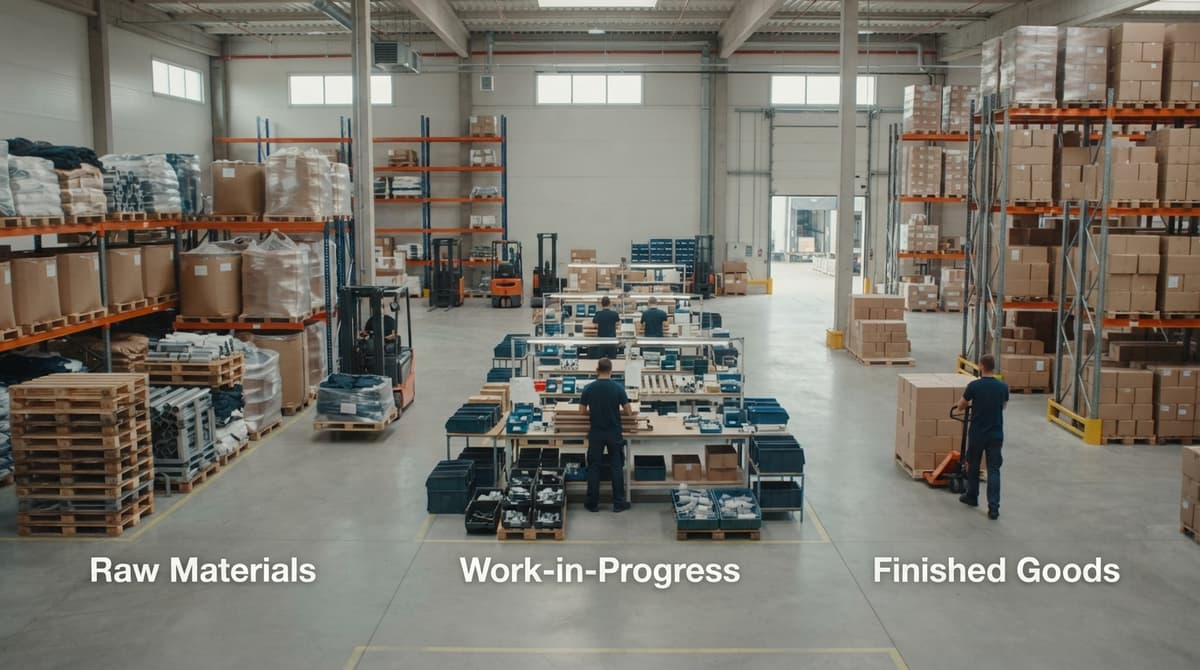
3 Types of Inventory
The 3 types of inventory are raw materials, work in progress (WIP), and finished goods. Raw materials are the basic items used to make a product. WIP is a product that is partly made. Finished goods are ready to sell or ship. Each type needs its own count.
Book a callWhat Are the 3 Types of Inventory?
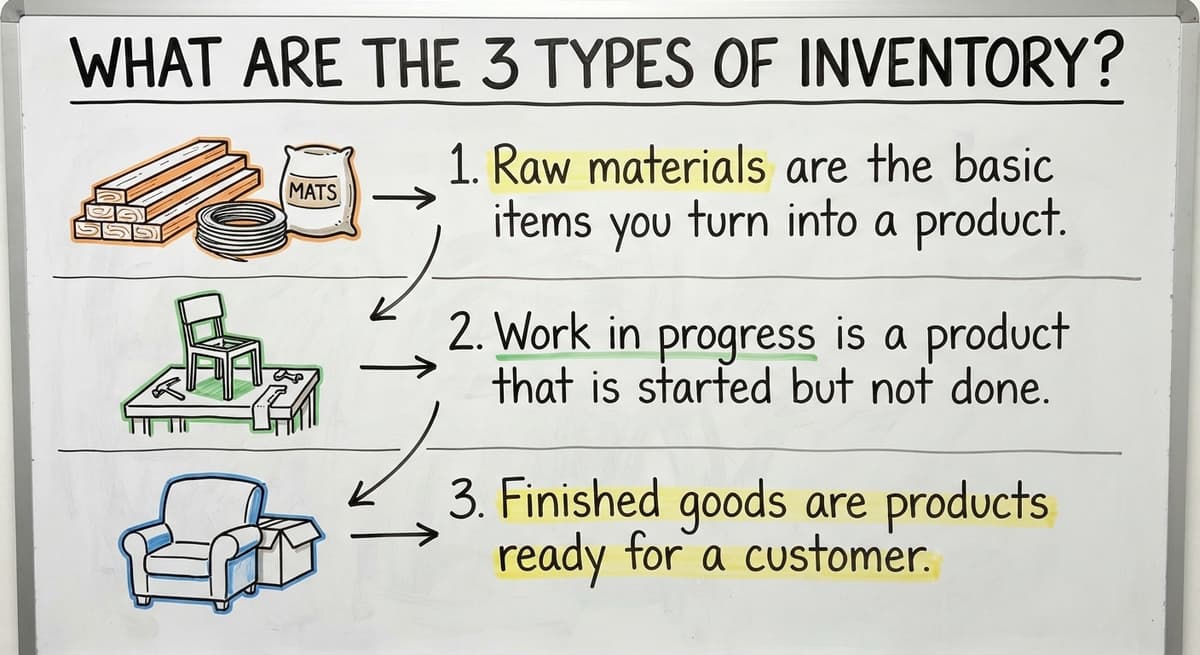
Inventory is anything a business holds to make or sell. Every item you hold fits one of 3 stages:
Reviewed November 2026.
- Raw materials are the basic items you turn into a product.
- Work in progress is a product that is started but not done.
- Finished goods are products ready for a customer.
A manufacturer holds all 3. A distributor mostly holds finished goods. Knowing which stage an item is in tells you how to handle it.
What are the different types of inventory?
The core list has 3 types: raw materials, WIP, and finished goods. Some lists add extra groups, such as maintenance supplies, for a longer view.
We build it for your operation, and the first look is free
If you would rather not compare products, describe how your operation already works and we build the system around it.
No build cost. You see it running on your own process first, and the monthly subscription starts only once it is live.
Book a callWhy Inventory Types Matter
Mix them up and your stock numbers go wrong. Then you buy the wrong things. GS1, the standards group behind barcodes, calls its system "the global language of business". A scan only helps when every item has a clear stage and place.
Each inventory type sits at a different stage and carries different costs and risks. Raw materials can spoil. WIP can stall. Finished goods can sit unsold. The type tells you how to count, store, and value the item.
Clear types give you counts you can trust.
What Are Raw Materials in Inventory?
Raw materials are the basic items a business uses to make a product. Examples include steel, flour, fabric, and plastic pellets. Manufacturers hold them. Some light-assembly warehouses hold them too, such as boxes, labels, and foam used to pack kits.
If you only resell goods, you may hold none. Raw materials are the first stage. Everything else grows from them.
A shop that runs out of one part stops the whole line.
What to Watch With Raw Materials
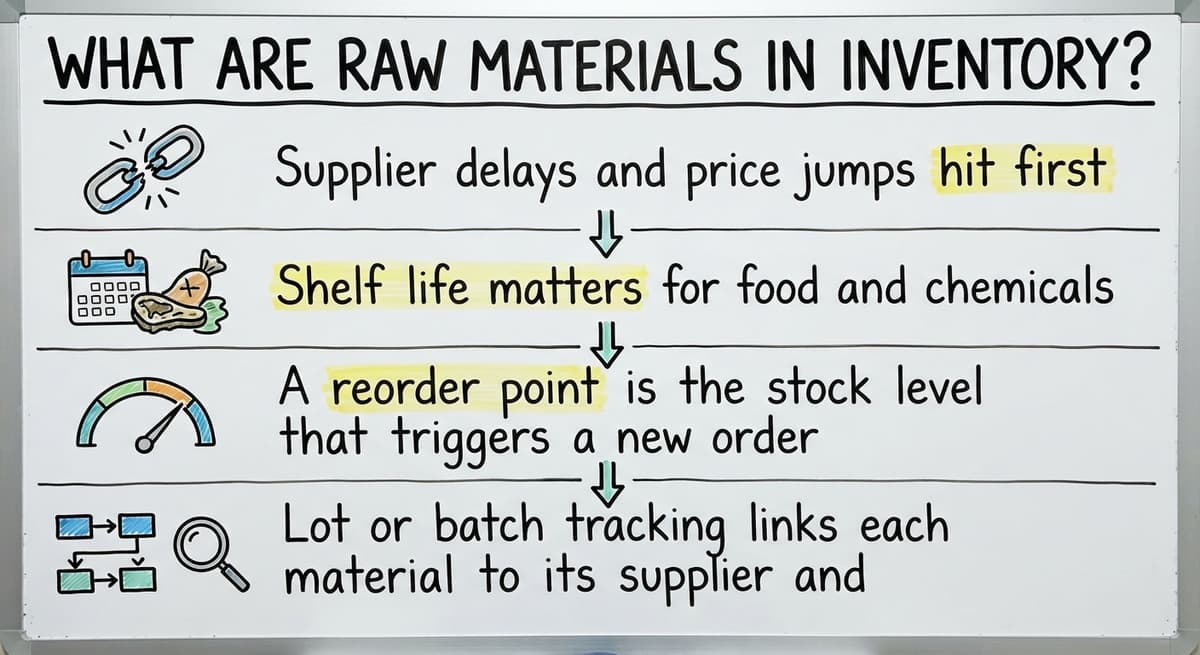
Raw materials carry risks upstream of your own floor. Four checks keep them under control:
- Supplier delays and price jumps hit first, so know your backup source.
- Shelf life matters for food and chemicals, so use the oldest stock first.
- A reorder point is the stock level that triggers a new order. Set it before production stalls.
- Lot or batch tracking links each material to its supplier and date. Use it where recalls are possible.
The cost of a missed reorder is a stopped line.
What Is Work in Progress (WIP) Inventory?
WIP inventory is any item that is partly made and not ready to sell. A half-built pallet kit is WIP. So is a cabinet that is partly assembled. Work in progress is the hardest type to see on paper. Items sit on carts, benches, and floor spots. Few people write them down.
A count that skips WIP understates what you own. It also hides where the work is stuck.
What to Watch With Work in Progress
WIP is easy to lose because it moves between steps and stations. Watch for these:
- Items vanish between steps when no one records the hand-off.
- Delays pile up at one station while others sit idle.
- Simple status labels work well: started, in process, done.
- Kitting (bundling items into one sellable set) and light assembly in a distribution center count as WIP.
Three status labels give you a view of WIP without new tools.
What Are Finished Goods in Inventory?
Finished goods are products that are ready to sell or ship. Boxed goods on a shelf are finished goods. So are pallets staged for an order. This is the main type for wholesalers, distributors, and fulfillment centers. Their whole business is moving finished goods in and out.
The US Census Bureau tracks wholesale firms through its Monthly Wholesale Trade report. Its inventories-to-sales ratio shows how much stock sits against what sells.
What to Watch With Finished Goods
Finished goods tie up your cash, so small errors cost real money. Four risks matter most:
- Stockouts lose sales. Overstock locks up space and cash.
- Slow movers sit for months. Review them on a set schedule.
- Bin locations (the shelf spot for each item) must be exact, or pickers lose time and ship wrong items.
- Counts must match what you promise on orders. The FTC rule on mail, internet, and phone orders expects you to ship when you said you would.
An accurate count protects both your cash and your word.
Not sure this is the right shape for your operation
Describe how the work runs today. We map it on a call and show you what it would look like built around that, before you spend anything.
Book a callHow Do the 3 Types of Inventory Compare Side by Side?
The 3 types differ by stage, example, main risk, and holder. The table puts all four in one place.
| Type | Stage | Example | Main risk | Who holds it |
|---|---|---|---|---|
| Raw materials | Before making | Steel, flour | Delays and spoilage | Manufacturers |
| Work in progress | During making | Half-built kit | Lost or stuck items | Makers, light assembly |
| Finished goods | Ready to sell | Boxed goods | Stockouts, slow sellers | Distributors, wholesalers |
Stage decides risk, and risk decides how you track.
Which three types of inventory are held in a manufacturing business?
A manufacturing business holds raw materials, work in progress, and finished goods. Each one marks a stage from input to output.

Which Types Does a Distributor or Warehouse Hold?
A wholesale distribution business holds mostly finished goods. A fulfillment center holds finished goods for clients and sometimes builds kits. Light assembly or private labeling adds WIP. Match your tracking to the types you actually hold.
For warehouse inventory, that means:
- Wholesalers track finished goods by item and bin.
- Fulfillment centers track client stock by owner as well.
- Kitting teams add a WIP status for each open job.
A tool built for 3 types is wasted on a business that holds 1.
Other Ways to Group Inventory
Some lists add MRO inventory as a fourth group. MRO means maintenance, repair, and operating supplies, such as gloves, tape, and forklift parts. You use them to run the building, not to sell.
Other labels sit on top of the 3 types. Cycle stock is what you sell in normal flow. Safety stock is a buffer. Dead stock never sells. ABC grouping, the idea behind what is b type of inventory in warehouse management, ranks items by value. These are labels, not replacements. You can read more on types of inventory control, what is inventory management and its types, 7 types of inventory, and what are the 4 types of inventory management.
Is MRO a type of inventory?
MRO is a common extra group, not one of the 3 core types. It covers supplies that keep operations running.
How Inventory Is Valued and Counted
Each type adds cost as it moves toward finished goods. Raw materials carry the buy price. WIP adds labor and overhead, such as rent and power. Finished goods carry all 3 costs. The IRS states in Publication 538: "To figure taxable income, you must value your inventory at the beginning and end of each tax year."
So counts feed your books. QuickBooks inventory holds the financial side well. It cannot tell you that a kit sits half built on bench 4.
Common Mistakes When Tracking Inventory Types
Four errors show up again and again:
- Teams count WIP as finished goods, or skip it.
- Separate sheets for each type do not match.
- Counts update once a week instead of when stock moves.
- One key employee holds the system in memory.
Each mistake has the same root: the count and the stock drift apart.
The comparison is easier when one option is built for you
Off-the-shelf means fitting your process to the software. We do it the other way round, and the first look costs nothing.
Book a callHow Do Small Teams Track All Three Types Today?
Most small teams use QuickBooks plus Excel, Access, printed sheets, and email. This setup works at low volume. One person knows where everything lives. It breaks as orders grow.
Watch for these signs that a manual inventory system is failing:
- You oversell items that were not in stock.
- Staff recount shelves to trust the numbers.
- The same data goes in 2 or 3 places.
The cost is real. Say 3 people spend 6 hours a week on double entry at $22 an hour. That is 3 x 6 x 52 x $22, or $20,592 a year. The Bureau of Labor Statistics publishes pay for stock clerks and order fillers if you want to use your own wage.
When double entry costs more than a tool, the setup has run its course.

What Does Good Inventory Tracking Look Like?
Good inventory tracking gives you one place to see stock by type and location. Counts update as items move. Low stock sets off an alert. The floor team can use it daily without training.
That last test matters most. A system that only the office can run will fall behind the shelf. Good inventory management keeps the count and the stock in step. NIST's Manufacturing Extension Partnership offers vendor-neutral guidance on supply chain and inventory process.
A tool the floor uses beats a tool the office admires.
Do You Need a Big ERP to Track Inventory Types?
No. A big ERP (a large system that runs a whole company) is not required. Wariness of long, costly rollouts is fair. Many small warehouses never need that scale.
Another path is custom software built around how your operation already works. Keep QuickBooks where it helps. Replace only the manual parts, such as the spreadsheets and paper sheets.
The Software Society is local to Columbus, Ohio. We build custom workflows for growing companies and work at small scale. If you are weighing warehouse inventory management software, warehouse inventory tracking software, or warehouse inventory management systems, start with your gaps, not a feature list.
Fix the manual steps first. Buy scale only when you need it.
A Simple Way to Start This Week
You can review your inventory this week with no buy. Follow these steps:
- Name which of the 3 types you hold.
- Map where each type is tracked: system, sheet, or paper.
- Find the biggest gap between the count and the shelf.
- Pick one manual process to fix first.
Write each answer on one page. The page shows you where to act first.

Next Steps for Your Operation
The 3 types of inventory are raw materials, WIP, and finished goods. Each needs its own count. If you want to talk through how your stock is tracked now, The Software Society is glad to listen. No pitch is required.
Frequently asked questions
What are the different types of inventory?
The core list has 3 types: raw materials, work in progress, and finished goods. Some lists add MRO supplies, cycle stock, safety stock, and dead stock as extra labels.
Which three types of inventory are held in a manufacturing business?
A manufacturing business holds raw materials, work in progress, and finished goods. Each marks a stage from input to output. Raw materials come first, and finished goods come last.
Is MRO a type of inventory?
MRO is a common extra group, not one of the 3 core types. It covers maintenance, repair, and operating supplies that keep the building running. You do not sell them.
What is the difference between WIP and finished goods?
WIP is partly made and cannot be sold yet. Finished goods are complete and ready to ship. A half-built kit is WIP. A boxed kit on a shelf is a finished good.
Which type matters most for a distributor?
Finished goods matter most. A distributor lives on accurate counts of items ready to ship. If you build kits, WIP matters too.
Do small warehouses need an ERP to track inventory?
No. Many small warehouses do well with a tool built around their own steps. Keep QuickBooks for the books.
What are signs a manual inventory system is breaking down?
Oversells, repeated recounts, and double entry are the clearest signs. Missing WIP is another.
Start with a free first look
A 30 minute call, your operation mapped, and a clear picture of what we would build. No obligation and nothing to install.
Book a callRelated guides
More on the same work.
Guides
- Types of Inventory Control
- 7 Types of Inventory
- Types of Stock Control Systems
- Warehouse Management System Types
- Best Inventory Software
- Classification of Inventory
- Excess Inventory
- Closed for Inventory
- Multi Location Inventory Management Software
- Ms Excel Inventory Template
- Inventory Management for Multiple Locations
- Costing Inventory
- Is Inventory a Long-term Asset
Common questions
- What is Inventory Management and Its Types
- What Are the 4 Types of Inventory Management
- What Are the Four Types of Wms?
- What is B Type of Inventory in Warehouse Management
- What Are the 7 Types of Warehouses?
- How to Keep Track of Inventory
- What is the Difference Between Aggregate and Item Inventory Management
- What is Jit Inventory Management
- What is Kanban System of Inventory Management
- What is the Definition of Inventory Management
- Mro Inventory Meaning