


Drop Ship Inventory Management
Drop ship inventory management means tracking supplier stock, routing orders, and confirming fulfillment for products you sell but never physically handle. It matters because errors at the supplier level become your customer's problem. This guide covers the full working picture for small and mid-size wholesale distributors, updated October 2026.
Book a callWhat Drop Ship Inventory Management Actually Means
In a drop ship model, you take the order and your supplier ships directly to your customer. You never touch the product. That sounds simple, but managing supplier stock visibility, order status, and fulfillment confirmation is still your job. The US Federal Trade Commission's Mail, Internet, or Telephone Order Merchandise Rule holds you responsible for shipping when you said you would, regardless of who actually ships. Drop ship inventory management is the system that keeps those commitments. For wholesale distributors juggling multiple suppliers, it is harder than it looks.
We build it for your operation, and the first look is free
If you would rather not compare products, describe how your operation already works and we build the system around it.
No build cost. You see it running on your own process first, and the monthly subscription starts only once it is live.
Book a callWhy Drop Shipping Complicates Inventory Tracking
Supplier data is the core problem. Stock levels change between the moment a customer orders and the moment you confirm. Multiple suppliers send data in different formats at different intervals. As GS1 notes on its barcode standards page, "GS1 standards are the most widely used supply chain standards system in the world," yet many small suppliers still send inventory updates by email or CSV rather than any standard feed. Errors surface after the sale is made, which is the worst possible time. Drop shipping inventory tracking that depends on manual checks cannot keep pace with that reality.
The Real Cost of Manual Tracking
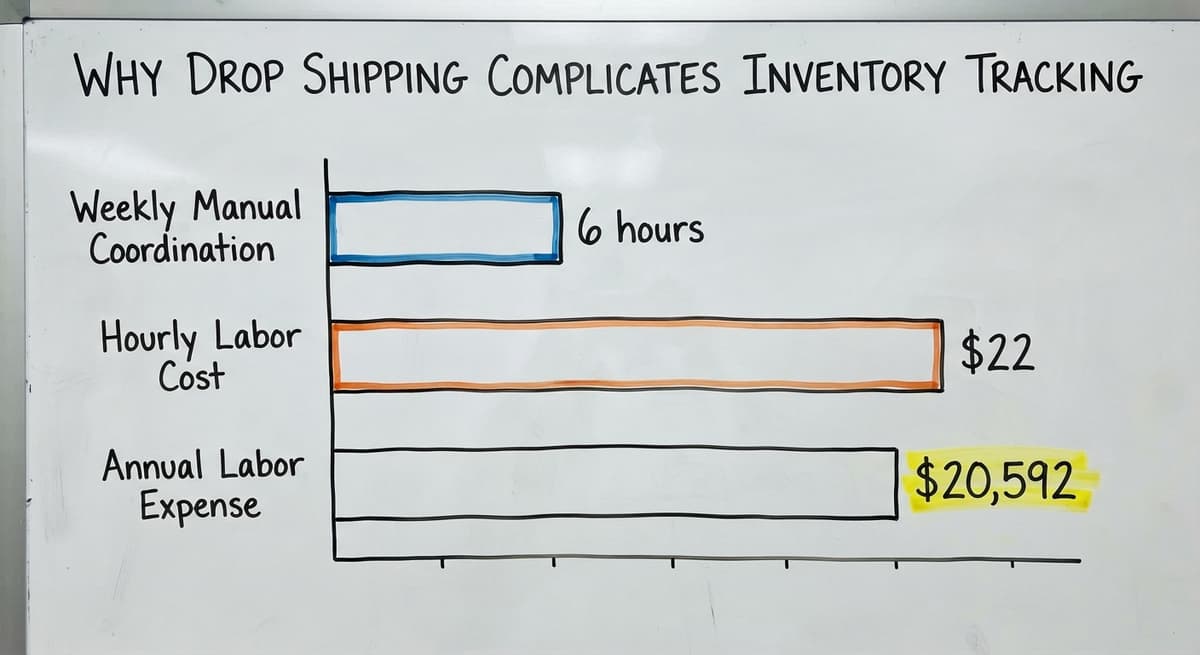
Consider 3 staff members each spending 6 hours a week on manual order coordination: copying details from email into spreadsheets, checking supplier portals, and updating an accounting package by hand. At the median wage for shipping and receiving clerks of about $22 per hour, that is roughly $20,592 a year in labor before a single oversell or customer complaint is counted. Overselling a product a supplier quietly ran out of adds refund costs and erodes trust. Customer service time spent chasing shipment status across a dozen portals adds more. The expense is real and it compounds.

Where Your Accounting Software Helps and Where It Stops
Your accounting software handles invoices, payments, and cost of goods well. It was not built for real-time supplier stock feeds or automated order routing. Most distributors end up using it for accounting and building workarounds everywhere else: a spreadsheet for stock levels, email threads for supplier confirmations, manual entries to reconcile the two. The goal is not to replace your accounting software but to stop asking it to do things it was never designed for. A purpose-built working layer handles the supplier coordination above your accounting software, then pushes clean financial data back down.
IRS Publication 538 states: "To figure taxable income, you must value your inventory at the beginning and end of each tax year." That obligation does not disappear in a drop ship model; it just needs a different data source.

Core Functions of Drop Ship Inventory Management Software
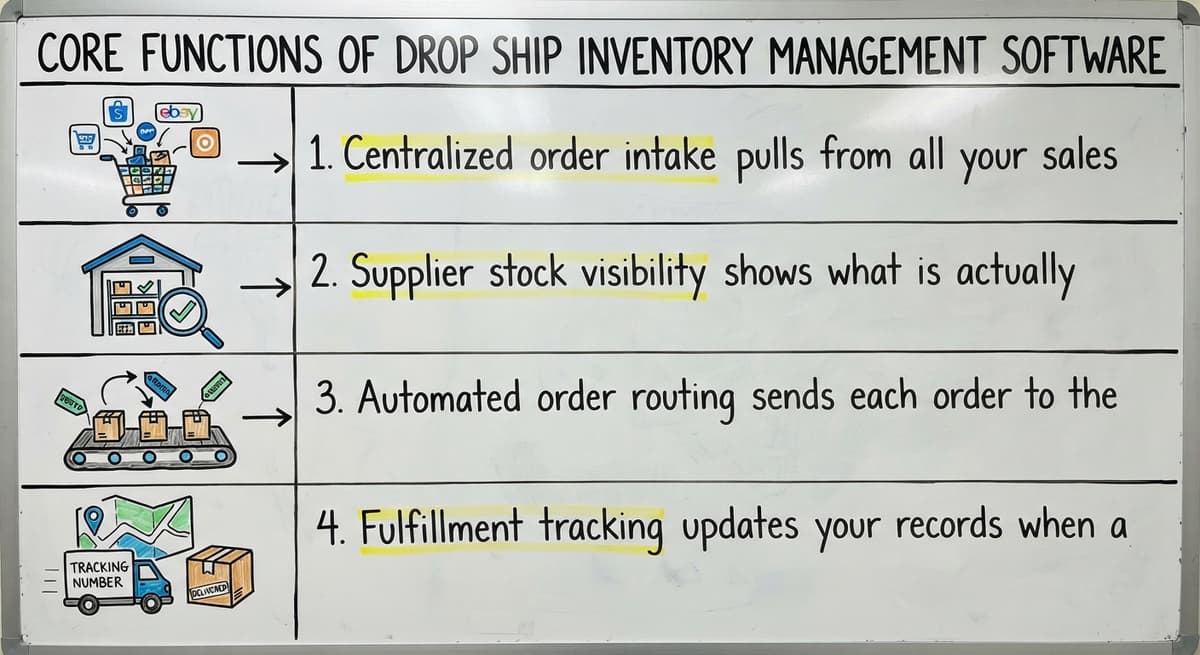
Good drop ship order management software does 4 things your spreadsheets cannot.
- Centralized order intake pulls from all your sales channels into one view so no order gets missed or double-entered.
- Supplier stock visibility shows what is actually available before you confirm a sale, not after.
- Automated order routing sends each order to the right supplier based on rules you set, without manual decisions.
- Fulfillment tracking updates your records when a shipment is confirmed or delivered, without anyone logging into a portal.
Those 4 functions replace the manual coordination that currently costs your team hours each week.
The comparison is easier when one option is built for you
Off-the-shelf means fitting your process to the software. We do it the other way round, and the first look costs nothing.
Book a callHow Does a System Handle Supplier Data That Arrives in Different Formats?
Suppliers send inventory data as EDI files, CSV exports, API calls, or plain email attachments. Good drop ship inventory management software normalizes those formats so your team sees one clean picture regardless of source. Automated syncing cuts the lag between a supplier's stock change and your system knowing about it. Even suppliers without modern systems can be connected through a middleware layer, which is software that translates one data format into another. The result is a single, current view of supplier stock across every source.

Order Routing Logic That Matches How You Actually Work
Not every distributor routes orders the same way. Your supplier agreements and margins should drive the rules, not a platform's defaults. Common routing logic includes:
- Lowest cost supplier for a given SKU
- Fastest estimated ship time to the customer's location
- Geographic proximity to reduce freight cost
- Preferred supplier first, with a named backup if stock is low
- Split-shipment rules when no single supplier can fill the full order
Custom logic matters because your supplier mix is specific to you. Inventory management software for wholesale distributors that forces you into preset rules creates new workarounds rather than removing old ones. The system should apply your rules automatically every time.

How Can Software Prevent Oversells Before They Happen?
Overselling is the most damaging mistake in drop ship operations, and software prevents it by shrinking the window where it can occur. Real-time or near-real-time supplier stock feeds mean your available inventory reflects current reality rather than yesterday's CSV. Beyond live feeds, 2 extra controls matter:
- Buffer stock rules let you treat a supplier's last few units as unavailable until confirmed, so you are not selling the final 3 units of something that may already be spoken for.
- Automatic holds and alerts pause new orders and notify your team when a supplier's stock drops below a set threshold, giving you time to act before a customer is affected.
Oversell prevention is where drop shipping inventory tracking pays for itself fastest.

Handling Returns and Connecting Data Back to Your Accounting Software
Returns are more complex in a drop ship model because the product never came from your warehouse. The software needs to track whether a return goes back to the supplier or to you, capture the supplier's return approval number, apply any restocking fees, and generate the right credit memo. A clear returns workflow keeps your margin intact and the customer experience clean.
On the financial side, every confirmed shipment creates a cost-of-goods entry. Accounting software integration for warehouse operations means that data lands in your accounting package automatically, matched to the order it fulfills, without manual matching. Supplier invoices can be checked against shipment records in the same step. Your books stay accurate without a second person verifying what the first person already entered.
See it running on your own process first
No build cost. The subscription starts once it is live and doing the job, not before.
Book a callWhat Reports Does an Operations Manager Actually Need?
Reporting in a drop ship system should answer the decisions your team makes daily. Useful reports include:
- Supplier on-time fulfillment rates so you know which partners are causing delays
- Margin by supplier, product line, or sales channel to see where profit actually comes from
- Oversell frequency and where in the process each error occurred
- Open orders by supplier so nothing falls through the gap between confirmation and shipment
Reports built around real decisions are more useful than dashboards that look complete but answer nothing specific.
When Your Operation Has Outgrown Spreadsheets
The signs are specific. Orders get lost between email and the spreadsheet. Staff spend more than a few hours each week on manual status checks. Oversells happen more than once a month. The US Census Bureau's Monthly Wholesale Trade data shows that wholesale inventories move fast; a process built on static spreadsheets cannot track a dynamic supply chain.
The problem is not the people. It is the process tools they have been given. Small and mid-size distributors do not need an enterprise ERP to fix this. A system scoped to your operation replaces the manual steps without disrupting what already works. The NIST Manufacturing Extension Partnership offers vendor-neutral guidance on supply chain process improvement that confirms this: the right intervention matches the scale of the operation.
What Does a Day Look Like with the Right Drop Ship Inventory System?
A realistic day runs like this: an order arrives and the system checks supplier stock automatically. It routes the order to the best supplier based on your rules. A confirmation goes to the customer. Shipment status updates flow in without anyone logging into a portal. When the supplier confirms delivery, the cost-of-goods entry pushes to your accounting software. Staff interact with 1 screen instead of switching between email, spreadsheets, and supplier portals. Exceptions surface automatically so the team focuses on solving problems rather than hunting for them. The outcome is fewer errors, faster fulfillment, and less time spent on coordination that software can handle.
Custom Software vs. Off-the-Shelf Drop Ship Tools
Off-the-shelf platforms assume a standard workflow. If your supplier mix, routing rules, or return process does not fit that assumption, you end up building workarounds inside the new tool, which is the same problem you had before. Custom inventory software is shaped around how your operation already runs. Faster adoption follows because the team is not learning someone else's logic. Custom warehouse management software built at this scale does not need a dedicated IT department to run or keep. The right fit means go-live is faster and the system stays useful as your supplier mix changes.
Questions to Ask Before Choosing a Drop Ship Inventory Solution
Before committing to any platform, get clear answers to these 4 questions.
- Can it connect to the supplier data formats you already receive? EDI, CSV, and API all need different handling.
- Does it integrate with your accounting software without replacing it? The accounting layer should stay in place.
- Can routing rules be customized to match your supplier agreements? Generic defaults will not reflect your margins.
- Who builds and supports the system, and are they reachable when something breaks? Support response time matters more than feature lists.
Start by mapping where your current process breaks down: oversells, manual entry points, supplier data gaps. Identify which steps cost the most staff time or create the most customer complaints. Order management software for distributors that addresses your specific gaps is worth more than a broader platform that addresses none of them precisely. A short discovery conversation with a software partner can turn that map into a buildable plan. You do not need to solve everything at once. Start with the highest-pain step and build from there.
Frequently asked questions
Does dropshipping need inventory management?
Yes. Even though you never hold stock, you are still responsible for tracking supplier stock levels, routing orders to the right supplier, and confirming fulfillment. Without a system for that, oversells and missed shipments happen regularly. The FTC holds sellers responsible for shipping when promised, regardless of who physically ships the product.
How to make $10,000 a month dropshipping?
There is no single formula. Revenue at that level depends on margin per order, order volume, supplier reliability, and how well your operation scales without adding proportional labor. The distributors who reach consistent revenue targets tend to have tight supplier data feeds, automated order routing, and a fulfillment process that does not need manual intervention on every order.
Is drop shipping dead in 2026?
No. Wholesale distributors have used drop shipping as a fulfillment method for decades, and that has not changed. What has changed is customer expectations around shipping speed and order accuracy. Operations that rely on manual tracking struggle to meet those expectations. The model works; the tools need to match the pace.
What is the most profitable item to dropship?
There is no single answer. Profitability depends on your supplier cost, the margin your market will bear, return rates, and how often the item goes out of stock. Products with stable demand, low return rates, and suppliers who provide reliable stock data tend to perform better in a drop ship model than high-velocity items with thin margins.
Do I still need inventory management software if I never hold stock?
Yes. Drop ship inventory management covers supplier stock visibility, order routing, and fulfillment status tracking. None of those happen reliably without a system. The IRS also needs inventory valuation at the start and end of each tax year, which applies even when a supplier holds the physical goods.
Can drop ship inventory software work alongside your accounting software without replacing it?
Yes. The working layer handles supplier coordination, order routing, and fulfillment tracking. Financial data, including cost-of-goods entries and supplier invoice matching, syncs back to your accounting software automatically. Your accounting setup stays in place; the new system handles what your accounting software was never built to do.
Is custom-built drop ship software realistic for a small distributor?
Yes. Purpose-built systems can be scoped and priced for operations well below enterprise scale. A business with 5 to 100 staff does not need an ERP. A system built around your existing workflow, supplier data formats, and routing rules will fit better and get adopted faster than a generic platform you have to adapt to.
How long does rollout take and how disruptive is it?
It depends on how many suppliers you have and how complex your routing rules are. Phased rollouts can show results within weeks rather than months. Your accounting software stays in place throughout. The new system is added above the existing process rather than replacing everything at once, which keeps daily operations running while the new layer is built out.
Start with a free first look
A 30 minute call, your operation mapped, and a clear picture of what we would build. No obligation and nothing to install.
Book a callRelated guides
The rest of this guide, for the parts of the job this page does not cover.
Guides
- Multi Location Inventory Management Software
- Inventory Management for Multiple Locations
- Inventory Management System for Manufacturing
- Inventory Management Pics
- B2b Inventory Management
- Jewelry Inventory Management
- Dental Inventory Management
- The Objective of Inventory Management is To
- Qr Code for Inventory Management
- Hvac Inventory Management Software
- Inventory Management Software for Schools
- Nonprofit Inventory Management
- Manual Inventory Management
- Inventory Management Photos
- Inventory Management Software Costs
- Hvac Inventory Management
- Automated Inventory Management System
- Multi Location Inventory Management
- Efficiency Inventory Management
- Medical Inventory Management
- Warehouse Shipment
- Warehouse Inventory Management Software
- Warehouse Inventory Management Systems