


Efficiency Inventory Management
Efficiency inventory management means having the right stock, in the right place, tracked in real time, with as few manual steps as possible. For a small distributor or warehouse running 5 to 100 people, that translates to fewer stockouts, fewer order errors, and less time spent fixing counts by hand. It does not need replacing your accounting package or hiring an IT team.
Reviewed and updated: October 2026
Book a callWhat Efficiency Inventory Management Really Means for Your Operation
Efficiency inventory management is not the same as having inventory software. You can digitize a broken process and still lose hours each week to reconciling numbers that never quite match. The goal is to remove the manual hand-offs, not to replicate them inside a new interface.
For wholesale, distribution, and warehouse operations, this means one system that updates stock counts when goods arrive, when orders ship, and when transfers move between locations. No parallel spreadsheets. No end-of-day data entry. The team does the work once, and the record updates itself.
The IRS makes inventory counting a legal obligation, not a preference. IRS Publication 538 states: "To figure taxable income, you must value your inventory at the beginning and end of each tax year." An efficient system makes that valuation accurate without a week of manual matching.
We build it for your operation, and the first look is free
If you would rather not compare products, describe how your operation already works and we build the system around it.
No build cost. You see it running on your own process first, and the monthly subscription starts only once it is live.
Book a callWhy Manual Tracking Kills Efficiency
The typical small distributor runs something like this: an accounting package for financials, a spreadsheet for stock counts, printed pick sheets on the warehouse floor, and email threads to flag reorders. Each hand-off between those tools is a chance for a number to go wrong.
A picker pulls from a bin. The sheet does not update until someone types it in. By the time the count reaches the spreadsheet, 3 more orders have shipped. The spreadsheet is already wrong.
That gap is manageable at 20 orders a day. At 200, it compounds fast. GS1, the global standards body behind barcode systems, notes that scan-based receiving and picking removes the transcription errors that manual entry introduces at every step. A scan logs the transaction the moment it happens. A typed entry logs it whenever someone gets around to it.
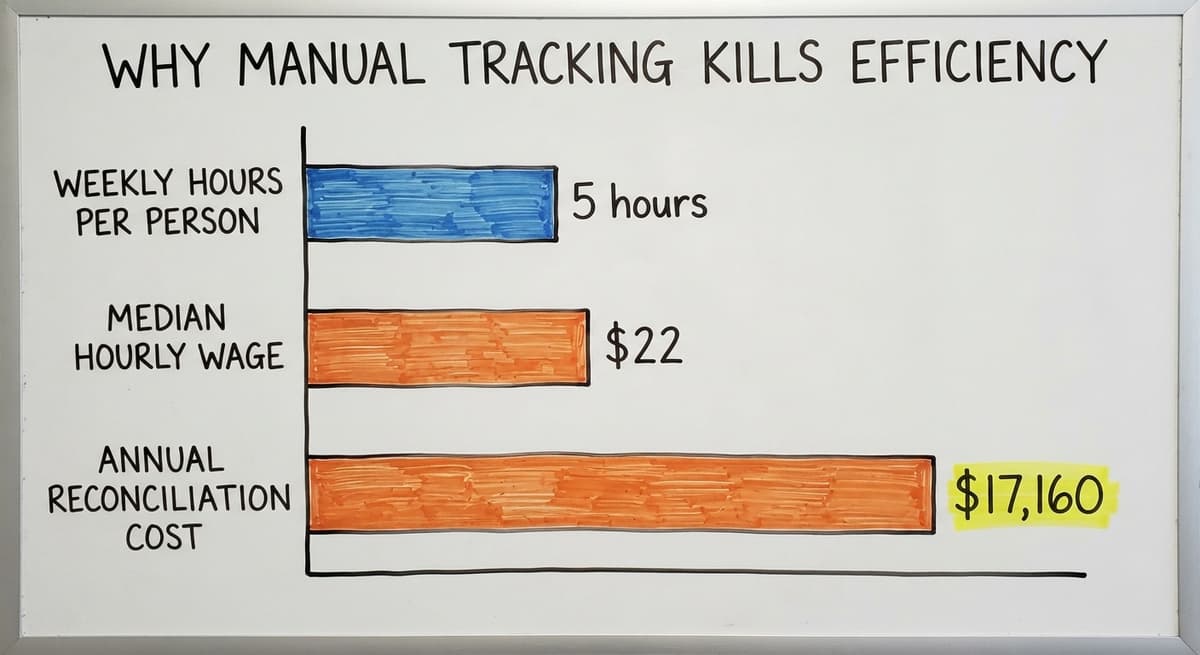
Consider the labor cost alone. 3 people spending 5 hours a week reconciling counts, at the median stock clerk wage of around $22 per hour per the Bureau of Labor Statistics, adds up to $17,160 a year. That is before counting the orders that ship wrong because the count was stale.
The Hidden Costs of Inventory Inefficiency
What does inventory inefficiency actually cost a small distributor? More than most owners expect, because the costs spread across cash, time, and customer trust at the same time.
Overstock ties up cash in goods sitting on shelves. That cash cannot pay suppliers early, fund a new product line, or cover payroll in a slow month. Stockouts cost sales and, more expensively, cost repeat customers who find a more reliable supplier.
Time spent reconciling spreadsheets is time not spent on receiving, shipping, or growing the business. Errors in manual counts flow directly into the accounting package, which means financial reports are built on wrong numbers. The US Census Bureau's Monthly Wholesale Trade data tracks the inventories-to-sales ratio across wholesale firms, and operations that carry too much or too little stock consistently underperform on that ratio compared to peers who manage counts tightly.
The FTC's Mail and Internet Order Merchandise Rule needs sellers to ship within the timeframe they promise. An inaccurate inventory count is one of the most common reasons a business cannot meet that obligation.
Core Principles of an Efficient Inventory System
A well-built warehouse inventory system rests on 4 principles. Each one addresses a specific failure mode in the manual approach.
- Real-time inventory tracking shows what you have, where it is, and what is already committed to open orders. No one has to call the warehouse to check.
- A single source of truth means one system updates automatically. There is no second spreadsheet to sync, no nightly import to run.
- Automated reorder triggers flag or create buy orders when stock hits a defined threshold. The manager does not have to remember every SKU's reorder point.
- Accurate demand history lets the system calculate smarter buying quantities based on what actually sold, not what someone guessed last quarter.
These principles apply whether you run 1 warehouse or 5. The NIST Manufacturing Extension Partnership recommends building inventory processes around verified data rather than institutional memory, specifically because institutional memory walks out the door when a key employee leaves.
The comparison is easier when one option is built for you
Off-the-shelf means fitting your process to the software. We do it the other way round, and the first look costs nothing.
Book a call
How Receiving, Cycle Counting, and Reorder Points Work Together
Receiving and Putaway: Where Inventory Accuracy Begins
Inventory accuracy starts the moment goods arrive, not at the time of sale. A receiving workflow that scans items in, matches them to the buy order, and updates the count automatically closes the gap between what you ordered and what you actually have.
Manual receiving looks different. A worker writes counts on a paper log. Someone else enters those counts later. Mismatches surface days after the truck left, when there is no way to verify what actually came in. Catching discrepancies at the dock, while the evidence is still present, is the most cost-effective place to protect inventory accuracy.
What Is the Difference Between Cycle Counting and a Full Physical Inventory Count?
Cycle counting means counting a rotating subset of SKUs on a schedule, rather than shutting the warehouse down for a full count once a year. A full physical count is disruptive and expensive. It also only catches errors once a year, which means a mistake made in February goes uncorrected until December.
Cycle counting catches errors sooner. An efficient system surfaces discrepancies automatically, so the team knows which bins to recount rather than counting everything. Errors caught early do not cascade into wrong financial reports or missed shipments.
How Do Reorder Points and Safety Stock Reduce Stockouts Without Overstocking?
A reorder point is the stock level that triggers a new buy order. Safety stock is the buffer kept on hand to absorb a demand spike or a supplier delay. Both numbers come from the same inputs: average daily usage and supplier lead time.
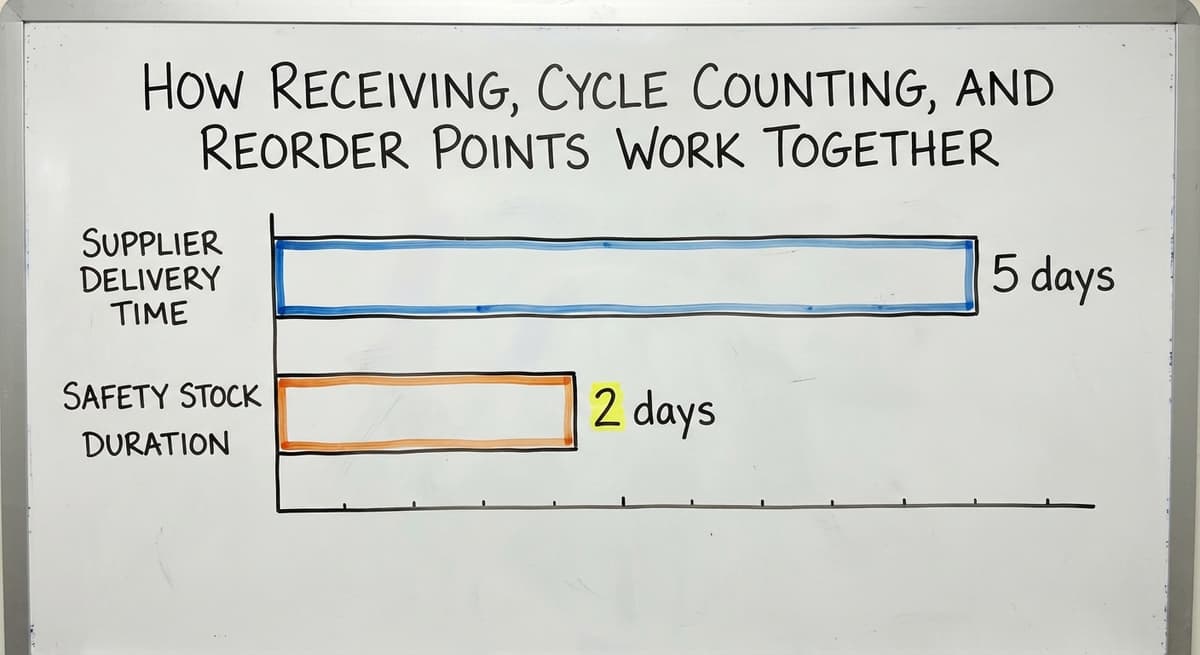
For example, if you sell 20 units a day and your supplier takes 5 days to deliver, your base reorder point is 100 units. Add 2 days of safety stock and the trigger becomes 140 units. An efficient system tracks those thresholds automatically and flags the reorder before the bin runs dry, rather than relying on a manager to notice the shelf is getting light.
Lot Tracking and Multi-Location Inventory Management
Does Your Operation Need Lot Tracking and FIFO Picking?
Lot tracking matters for distributors handling perishables, regulated products, or serialized goods. An efficient lot tracking system ties each unit to its receipt date, supplier, and expiration or warranty date, which enables first-in, first-out (FIFO) picking without manual sorting.
When a recall happens, lot tracking lets you identify exactly which units are affected and where they went. Without it, a recall means pulling everything from the category and hoping for the best. With it, you pull only the affected lot and notify only the customers who received it.
Managing Inventory Across More Than One Location
Distributors and fulfillment centers often stock goods across multiple warehouses or storage zones. Knowing total quantity is not enough. You need to know which location holds it before you can pick, transfer, or promise a ship date.
Transfers between locations should update both counts in real time. A separate spreadsheet to track transfers is just another manual hand-off waiting to create a discrepancy. Custom inventory software can map to the actual physical layout of your operation, using your bin labels and zone names, rather than forcing your team to translate a generic location structure into something that fits your floor.

Can You Improve Inventory Efficiency Without Replacing Your Accounting Software?
Yes. Many small distributors and warehouses rely on their accounting package for financials and have no reason to abandon it. The problem is not the accounting package. The problem is the manual bridge between it and everything else.
A well-built system posts the right data to your accounting software automatically: cost of goods sold, buy order receipts, inventory adjustments. The accounting team keeps working the way they always have. The warehouse team gets tools built for warehouse work, not tools borrowed from an accounting workflow.
How custom software integrates with existing accounting platforms for distributors is a common question, and the answer is straightforward: the integration pushes data one way, on a defined trigger, without anyone having to export a file or type a number twice. That is the manual step that disappears.
See it running on your own process first
No build cost. The subscription starts once it is live and doing the job, not before.
Book a callWhy Off-the-Shelf Platforms Often Fail Small Operations
Off-the-shelf inventory management software is built for a median customer. That customer is not you. Features designed for enterprise scale add complexity without adding value at 10 to 100 staff. Long setup timelines and high subscription costs are hard to justify when the operation is lean and the team is small.
Small distributors end up bending their process to fit the software. The software does not bend. So the team works around it, which means the spreadsheets come back, and now you are paying for a platform you are not actually using.
Replacing Excel and Access databases with purpose-built operations software solves a different problem than buying a pre-packaged platform. Purpose-built means the system matches your workflow, your terminology, and your sequence of steps. The team learns it quickly because it already looks like the job they do.
What Metrics Show That Inventory Efficiency Is Actually Improving?
The right metrics make improvement visible, rather than leaving the team to guess whether the changes are working. Track these 4 numbers on a regular cadence.
- Inventory turnover ratio measures how many times stock sells and is replaced in a period. Higher turnover means less cash sitting idle on shelves.
- Days on hand shows the average number of days stock sits before it ships. A shrinking number signals tighter buying.
- Order fill rate tracks the percentage of orders shipped complete on the first attempt. A fill rate below 95% usually points to an inventory accuracy problem.
- Shrinkage rate is the gap between recorded and physical inventory, expressed as a percentage. Cycle counting drives this number down over time.
An efficient system surfaces these numbers without a separate reporting project. If pulling a metric needs a manual export and a pivot table, the metric will not get pulled consistently.
How to Start Improving Inventory Efficiency Without Disrupting Operations
Begin by mapping the current process before changing anything. Write down every step from receiving to shipment. That map will show you where the delays and errors actually live, rather than where you assume they live.
Fix the single biggest source of errors first. A phased approach keeps the team on board and reduces the risk of a rollout that breaks more than it fixes. Trying to change everything at once is the fastest way to get the team to revert to the old process.
Custom warehouse management software for small operations is scoped to the exact size and complexity of the job. Nothing more, nothing less. The order fulfillment workflow automating for wholesale distributors that works for a 3-warehouse regional distributor looks different from what works for a single-site operation with 8 staff. A builder who walks your floor before writing a line of code will scope it correctly.
The custom software rollout process for small distribution businesses does not have to mean a 12-month project. A focused build that replaces only the manual parts, without touching the accounting package or retraining the whole team, can move faster than most owners expect.
Questions to Ask Before Choosing an Inventory Management Approach
Before committing to any system, get clear answers to these questions.

- Will this connect to your accounting package, or will it need replacing it?
- Can it handle your specific workflows, including lot tracking, multi-location stock, and any custom units of measure you use?
- How long will the build or setup take, and who does the actual work?
- Is the team that builds it also the team that supports it after launch, or does support route to a help desk that has never seen your operation?
A local team that can walk your warehouse floor, watch the actual workflow, and build to match it will answer all 4 questions clearly. Support becomes a conversation rather than a ticket number. For operations in and around Columbus, Ohio, proximity means the builder understands regional distribution patterns and supplier relationships, not just software architecture.
Start with an audit of your current process. Identify the one step that causes the most errors or delays. Scope a solution that fixes that step without disrupting the rest. Efficiency does not need a massive system or a long expensive rollout. It needs removing the right friction at the right point.
If you want to see what that could look like for your specific operation, reach out for a no-pressure walkthrough. Bring your current process, your pain points, and your questions. The conversation starts there.
Frequently asked questions
How do I well manage my inventory?
Start by documenting every step in your current process from receiving to shipment. Identify where errors and delays actually happen, then fix the biggest one first. Move toward a single system that updates stock counts in real time when goods arrive and when orders ship. Automated reorder triggers and cycle counting keep counts accurate between those events. The goal is to remove manual hand-offs, not to add more tools on top of the ones you already use.
What is EOQ and ROP?
EOQ stands for economic order quantity, which is the ideal order size that balances the cost of ordering too often against the cost of holding too much stock. ROP stands for reorder point, which is the stock level that triggers a new buy order. Both numbers come from your average daily usage and your supplier lead time. An efficient inventory system tracks ROP automatically and flags a reorder before the bin runs out, rather than waiting for someone to notice.
What is the best inventory management software for a manufacturing company?
There is no single best answer. The right fit depends on the size of the operation, the complexity of the workflows, whether lot tracking or multi-location stock is needed, and how the system will connect to existing accounting tools. A small operation with lean staff usually needs something scoped to its actual workflows rather than a platform built for enterprise scale. Options range from spreadsheets at the simplest end, to cloud inventory apps, to custom-built systems. The deciding factor is whether the software matches your process or forces you to match its process.
What are some common inefficiencies in inventory management?
The most common ones are manual data entry between disconnected tools, delayed receiving logs that let discrepancies hide for days, no automated reorder triggers so stockouts happen before anyone notices, and full physical counts done once a year instead of cycle counting on a rolling schedule. Each of these creates a gap between what the record says and what is actually on the shelf. Closing those gaps one at a time is how efficiency improves.
Can a business improve inventory efficiency without replacing its accounting software?
Yes. The accounting package is not the problem. The problem is the manual steps between the warehouse and the accounting package. A purpose-built inventory system can post cost of goods, buy order receipts, and adjustments to your accounting software automatically, without anyone exporting a file or entering a number twice. The accounting team keeps working the same way. The warehouse team gets tools designed for warehouse work.
How does lot tracking support first-in, first-out picking and recall traceability?
Lot tracking ties each unit to its receipt date, supplier, and expiration or warranty date. When the system knows which lot arrived first, it can direct pickers to that stock automatically, which enforces FIFO without manual sorting. If a recall happens, the system identifies exactly which lot is affected and which customers received it, so the response is targeted rather than pulling everything from the category.
What metrics show that inventory efficiency is actually improving?
Four numbers tell the clearest story: inventory turnover ratio, days on hand, order fill rate, and shrinkage rate. Turnover and days on hand show whether buying decisions are getting tighter. Fill rate shows whether accurate counts are translating into complete shipments. Shrinkage rate shows whether cycle counting is catching discrepancies before they grow. An efficient system surfaces all four without a manual reporting project.
How does custom-built inventory software differ from a pre-packaged solution?
A pre-packaged platform is built for a median customer and needs your operation to adapt to its structure. Custom-built software is scoped to your actual workflows, your terminology, and your physical layout. It replaces only the manual steps that cause errors, without adding features your team will never use. The rollout is faster because there is no excess to configure, and support comes from a team that already knows how your operation works.
Start with a free first look
A 30 minute call, your operation mapped, and a clear picture of what we would build. No obligation and nothing to install.
Book a callRelated guides
The rest of this guide, for the parts of the job this page does not cover.
Guides
- Multi Location Inventory Management Software
- Inventory Management for Multiple Locations
- Inventory Management System for Manufacturing
- Inventory Management Pics
- B2b Inventory Management
- Jewelry Inventory Management
- Dental Inventory Management
- The Objective of Inventory Management is To
- Qr Code for Inventory Management
- Hvac Inventory Management Software
- Inventory Management Software for Schools
- Nonprofit Inventory Management
- Manual Inventory Management
- Inventory Management Photos
- Inventory Management Software Costs
- Hvac Inventory Management
- Automated Inventory Management System
- Multi Location Inventory Management
- Medical Inventory Management
- Drop Ship Inventory Management
- Warehouse Inventory Management Software
- Warehouse Inventory Management Systems
- Quickbooks Inventory Management Software