

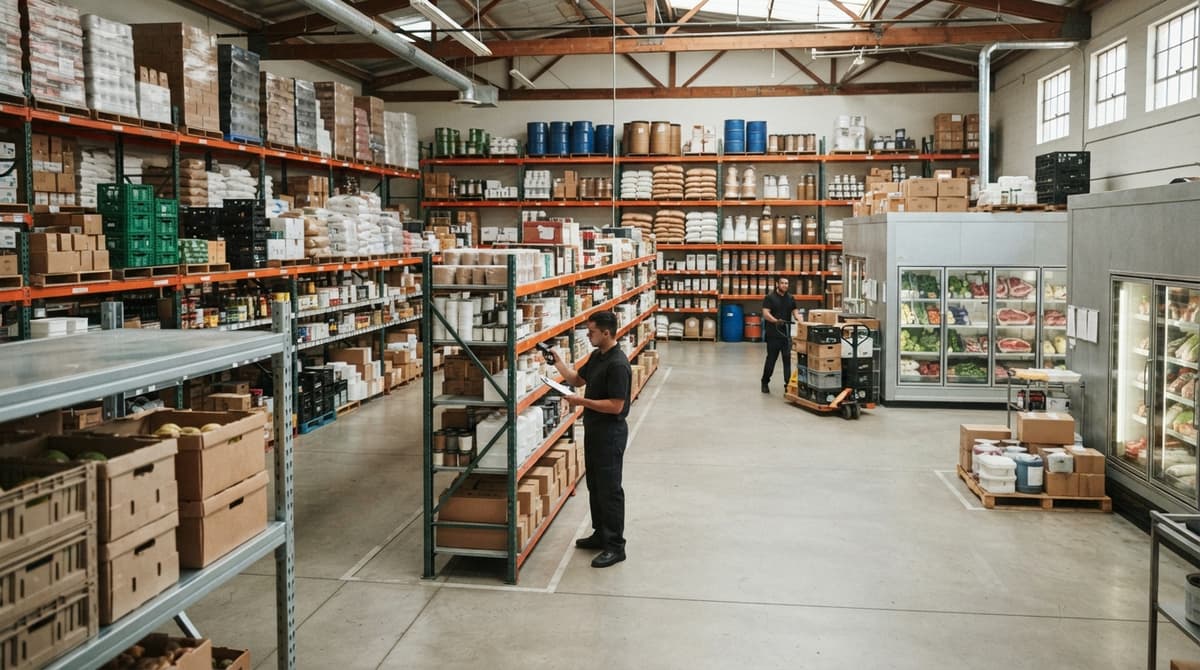
What Is Inventory Management In Restaurant
Inventory management in a restaurant means tracking every ingredient and supply from the moment it arrives to the moment it is used or thrown out. Good tracking keeps food cost in check, prevents waste, and makes sure the kitchen never runs short mid-service. This guide explains the full process in plain terms, reviewed and updated for current restaurant operations.
Book a callWhat Is Inventory Management in a Restaurant?
Inventory management in a restaurant is the practice of knowing exactly what stock you have, what you used, and what you need to order next. Every bottle, bag, and box gets logged when it arrives. Every portion used gets subtracted from that count. The result is a running picture of where your money sits on the shelf, and how fast it moves.
Reviewed October 2026.
The goal is simple: always have what you need, never more than you can use, and a clear record of where everything went. When that record is accurate, ordering becomes predictable and food cost stays under control.
We build it for your operation, and the first look is free
If you would rather not compare products, describe how your operation already works and we build the system around it.
No build cost. You see it running on your own process first, and the monthly subscription starts only once it is live.
Book a callWhat Gets Tracked in a Restaurant Inventory?
Anything that costs money and gets consumed belongs in your inventory count. That covers more than just food.
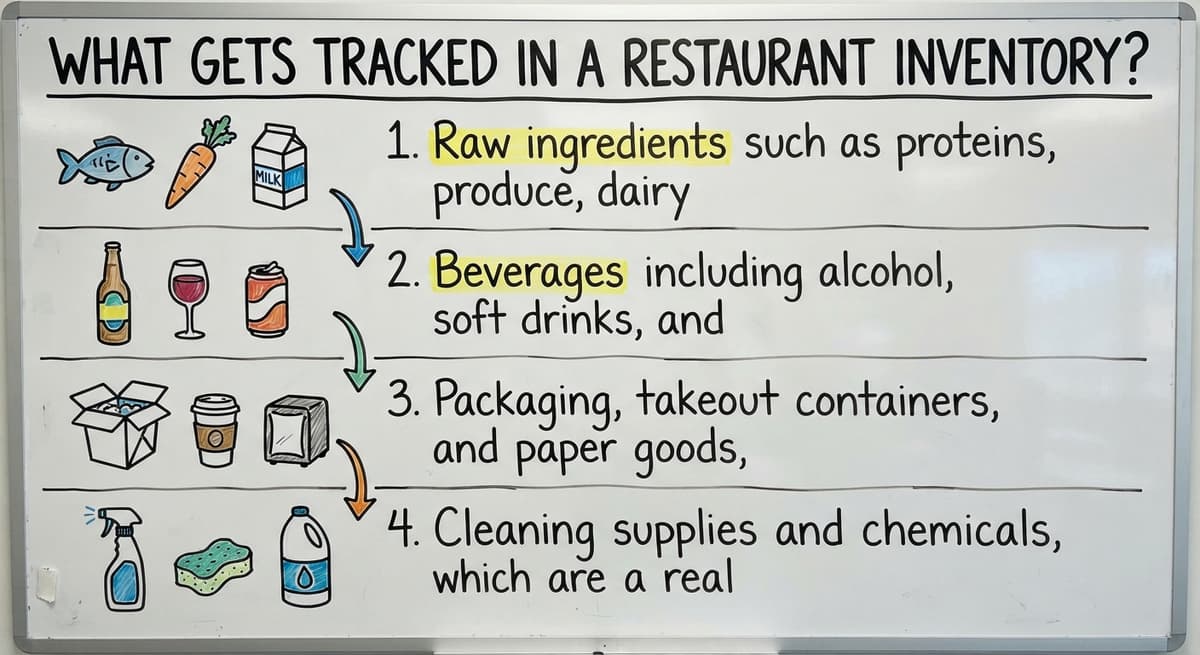
A complete restaurant inventory usually includes:
- Raw ingredients such as proteins, produce, dairy, and dry goods, because these drive the bulk of food cost
- Beverages including alcohol, soft drinks, and specialty items, each with its own consumption rate
- Packaging, takeout containers, and paper goods, which add up faster than most operators expect
- Cleaning supplies and chemicals, which are a real cost even if they feel invisible
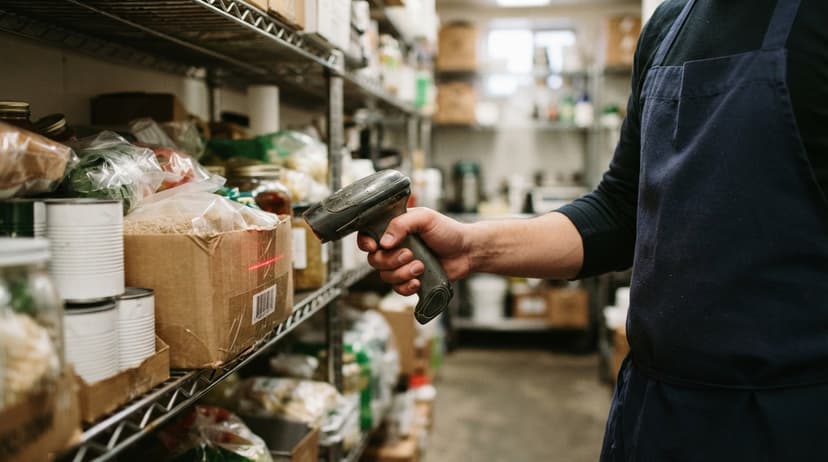
Scan-based receiving speeds this up. GS1, the global standards body for barcodes, notes that its barcode standards exist to let supply chain partners "identify, capture and share information" about products consistently, and you can read how those standards work at gs1.org/standards/barcodes. When a delivery has scannable codes, checking it in takes minutes instead of half an hour.
Why Does Inventory Management Matter for Restaurant Profitability?
Inventory management matters because food cost is usually the largest controllable expense a restaurant carries, often landing between 28 and 35 percent of total revenue. Every dollar of waste, theft, or over-ordering comes straight out of margin.
Poor stock tracking creates a chain of problems. Over-ordering fills the walk-in past capacity and pushes older product to the back, where it spoils before anyone uses it. Under-ordering means menu items run out during a busy Saturday dinner. Neither outcome is acceptable, and both are avoidable.
How Accurate Inventory Protects Profit
When you know exactly what you have and what you use, you order only what the sales data says you need. That discipline compounds over weeks and months into a measurable cost reduction.
The IRS adds a legal dimension to this. IRS Publication 538 states directly: "To figure taxable income, you must value your inventory at the beginning and end of each tax year." Read that requirement at irs.gov/publications/p538. Counting stock is not just a business habit; it is a legal obligation.
The Core Steps in the Inventory Management Process
Restaurant inventory follows a repeating cycle. Each step feeds the next, and skipping one breaks the whole chain.
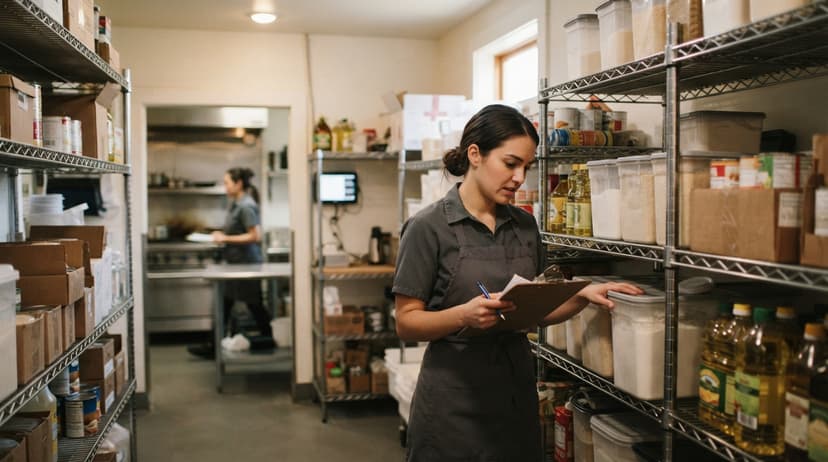
- Receiving: When a delivery arrives, verify that quantities and quality match the buy order before the driver leaves.
- Storage: Organize stock so older items sit at the front and get used first. This practice is called FIFO, which stands for First In, First Out.
- Counting: Perform physical counts on a regular schedule. High-cost items like proteins and alcohol warrant a daily count; dry goods can be counted weekly.
The comparison is easier when one option is built for you
Off-the-shelf means fitting your process to the software. We do it the other way round, and the first look costs nothing.
Book a callHow Count Data Drives Ordering
- Recording: Log actual usage against expected usage based on sales. The gap between those two numbers tells you where product is disappearing.
- Ordering: Use the count data to build buy orders that reflect what you actually need, not what you ordered last time.
The NIST Manufacturing Extension Partnership offers vendor-neutral guidance on supply chain discipline at nist.gov/mep/supply-chain, and the same principles that apply to manufacturing apply to a restaurant kitchen.
Why the Receiving Step Gets Skipped Most Often
Receiving is the step most kitchens rush. A delivery arrives during prep, the chef signs the invoice without checking weights, and 2 pounds of short-shipped protein gets paid for anyway. Over a month, those small gaps add real dollars to food cost. Building a receiving checklist and assigning one person to own it closes that leak fast.
Why FIFO Matters More Than It Sounds
FIFO is not a complicated idea. Newer stock goes behind older stock, every time, without exception. When staff pull from the front, the oldest product moves first and spoilage drops. The discipline only holds if storage is organized so the front is always accessible. A crowded walk-in with no clear lanes defeats the system before it starts.
Manual Tracking vs. a Dedicated Inventory System
Many restaurants start with spreadsheets, paper count sheets, or a notebook kept near the walk-in. Those tools are free and familiar, and for a very small operation they can work.
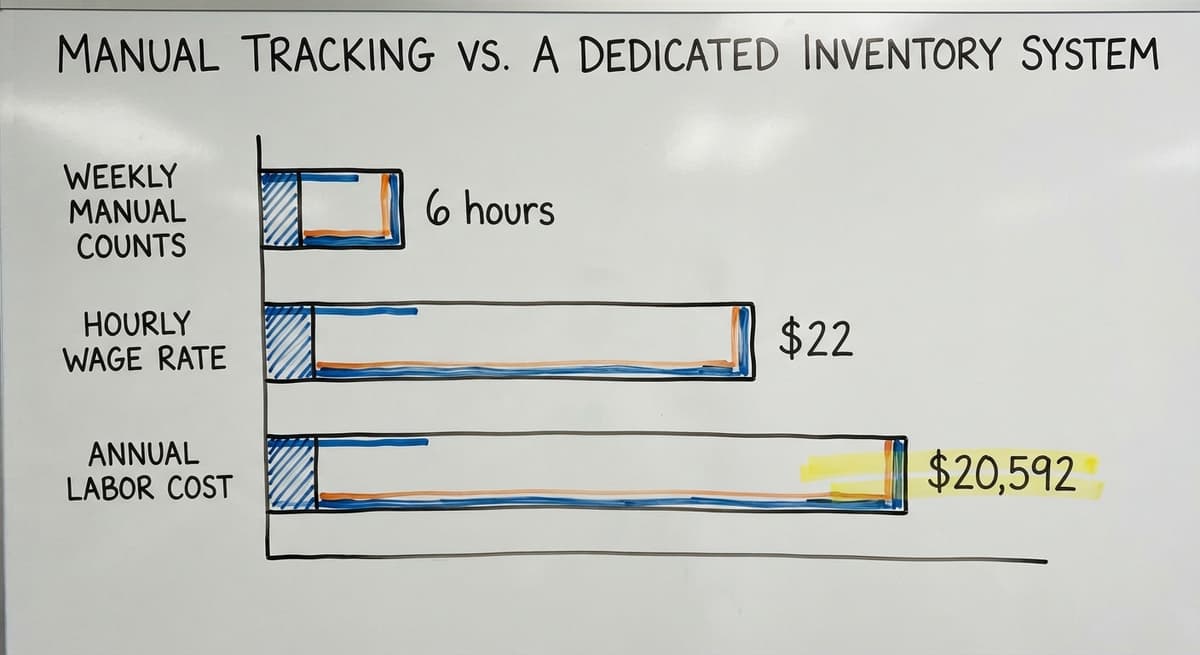
The limits show up fast. Manual counts take time. A team of 3 people spending 6 hours each week on manual counts, at a typical wage of around $22 an hour, costs roughly $20,592 a year in labor alone. That figure does not include the errors that come from different staff members measuring differently or transcribing numbers wrong.
What a Dedicated Inventory System Actually Does
A dedicated inventory system automates the count process, flags variances the moment they appear, and connects purchasing directly to sales data. When the system sees that a menu item sold 40 portions yesterday, it can calculate exactly how much of each ingredient was consumed and subtract it automatically.
The right fit matters more than the longest feature list. A small single-location diner does not need the same platform as a 20-unit group. Replacing manual spreadsheets with a custom operations system built around how the kitchen actually runs tends to get adopted faster than a platform that forces staff to change every habit they have. The Bureau of Labor Statistics tracks wages for stock and inventory clerks at bls.gov/oes/current/oes435071.htm, which gives a real baseline for calculating what manual processes cost versus what a system would save.
What a Good Inventory System Actually Does
A useful inventory system does a small number of things well. It logs deliveries against buy orders, tracks usage by recipe, alerts a manager when stock falls below a reorder point, and produces a food cost report without anyone having to build a formula. The simpler those functions are to use on a phone or tablet, the more likely the team will actually use them.
See it running on your own process first
No build cost. The subscription starts once it is live and doing the job, not before.
Book a call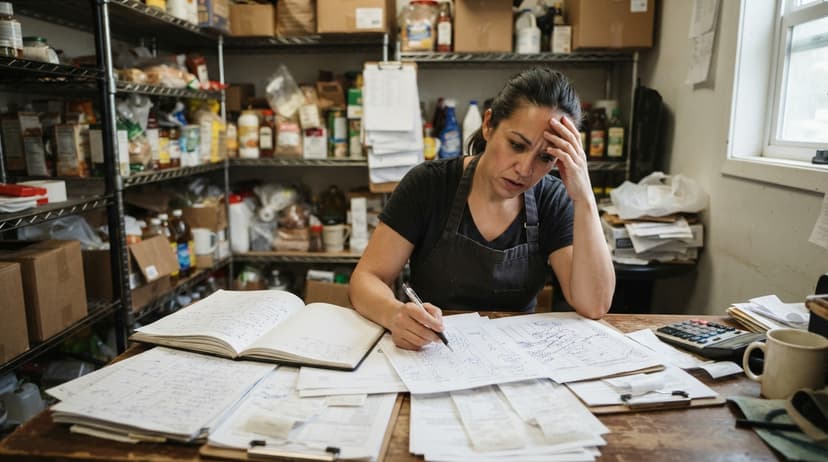
Key Metrics Every Restaurant Should Watch
Numbers only help when you know what they mean. These 4 metrics tell the story of how well your inventory is running.
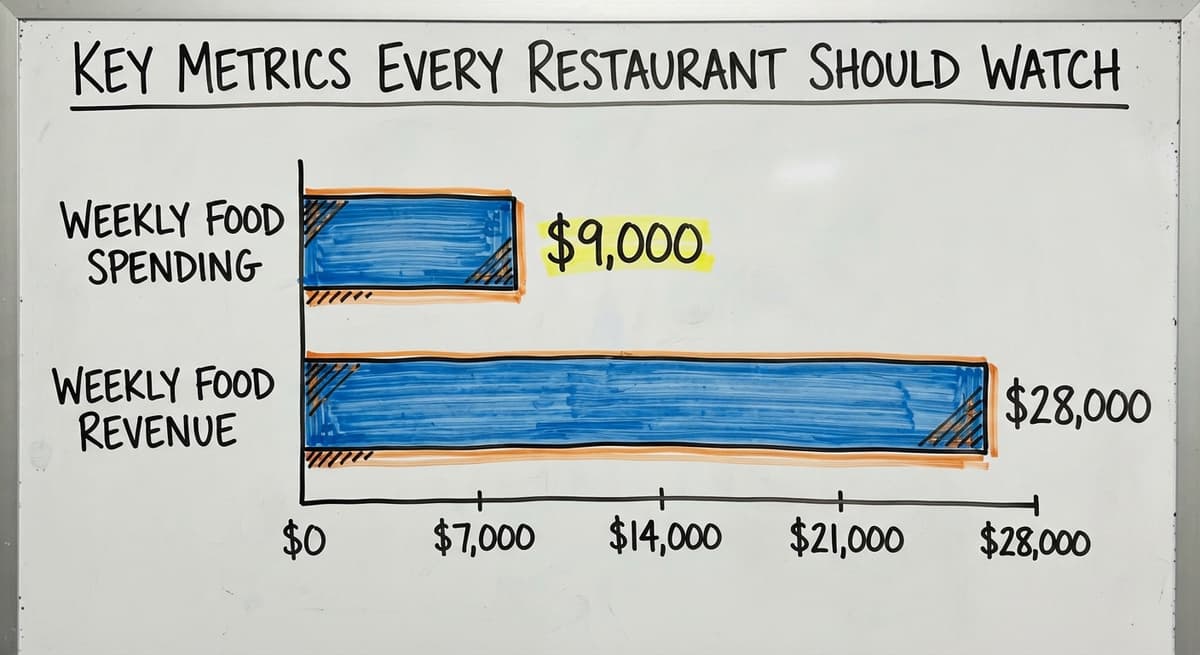
- Food cost percentage is actual food cost divided by food revenue, expressed as a percent. A restaurant spending $9,000 on food in a week with $28,000 in food revenue has a food cost percentage of 32.1 percent. Track it weekly so trends show up before they become problems.
- Variance, sometimes called shrinkage, is the gap between theoretical usage (what the recipes say you should have used based on sales) and actual usage (what physically left the shelf). A large variance points to theft, waste, or portion errors.
Why Turnover Rate and Days on Hand Complete the Picture
- Inventory turnover rate measures how quickly stock is used and replenished. A high turnover rate on perishables means product moves before it spoils. A low rate on the same items signals over-ordering.
- Days on hand tells you how many days of supply are currently sitting in the building. Too many days on hand ties up cash and raises spoilage risk. Too few risks running out before the next delivery.
Watching all 4 together gives a complete picture; watching just one can mislead you.

Common Inventory Problems Restaurants Face
Every restaurant runs into inventory problems. The good news is that each one has a fix.
- Spoilage from over-ordering happens when buy quantities are based on habit rather than sales data. The fix is setting reorder points tied to actual consumption, not last week's order.
- Theft or unrecorded waste inflates food cost without any obvious explanation. Regular counts, portion controls, and waste logs make it hard for product to disappear quietly.
Fixing Stock-Outs and Inconsistent Counts
- Menu items running out mid-service signals that reorder points were set too low or not set at all. A par level for each item, reviewed weekly, prevents the 86 list from growing during a rush.
- Inconsistent counts occur when different staff members measure differently. A chicken breast counted by weight on Monday and by piece on Friday produces useless data. Standard units and a written counting guide solve this.
None of these problems need a complete overhaul to fix. Each one responds to a specific, targeted change in process.
How Inventory Management Connects to the Rest of Operations
Inventory data does not live in isolation. It touches almost every other part of how a restaurant runs.
Buy orders flow directly from count data. When the count is accurate, the order is accurate, and cash does not sit tied up in excess stock. The US Census Bureau tracks inventories-to-sales ratios across industries at census.gov/wholesale/index.html, and the pattern is consistent: businesses that turn inventory faster carry less dead weight on the balance sheet.
Menu planning also depends on what the inventory says. When a manager knows the walk-in holds 30 pounds of salmon that needs to move in 2 days, a daily special is an obvious answer. Without that visibility, the salmon spoils and the loss hits food cost with no upside.
Not sure this is the right shape for your operation
Describe how the work runs today. We map it on a call and show you what it would look like built around that, before you spend anything.
Book a callHow Inventory Data Feeds Sales and Accounting
When inventory connects to sales data, managers can see which menu items drive the most waste and which drive the most margin. That combination shapes smarter menu decisions over time. For operations that track financials through an accounting package, inventory data can flow directly into cost-of-goods accounting, meaning food cost figures appear in the profit-and-loss report without anyone re-entering numbers by hand.
The value of good inventory data multiplies when it feeds the systems around it rather than sitting in a separate spreadsheet.
Inventory and Cash Flow
Over-ordering is a cash flow problem as much as a food cost problem. Money spent on product that spoils before it is used is money that cannot pay a supplier, cover payroll, or fund a repair. Operators who track days on hand and set firm reorder points free up working capital without reducing the quality or variety of what they serve.
How Do I Choose the Right Inventory Approach for My Restaurant?
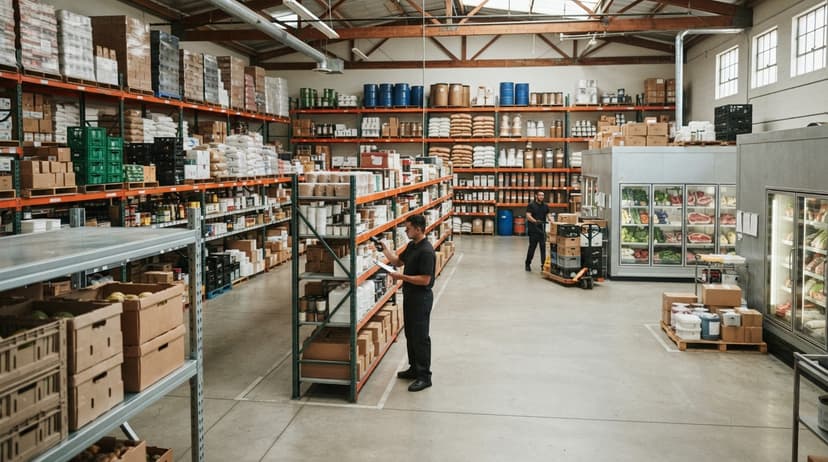
The right inventory approach is the one that fits how your operation actually runs today, not how a textbook says it should run. A single-location diner with 8 staff and a tight menu has different needs than a multi-unit group running a commissary kitchen that supplies 5 locations.
Start by asking 3 questions. First, how much time does the current process take each week, and is that sustainable? Second, where does the data break down, at receiving, at counting, or at ordering? Third, does the team actually use the tools already in place, or do they work around them?
When to Build Around Your Workflow Instead of Changing It
Custom or configurable systems can match existing workflows rather than forcing staff to learn an entirely new way of operating. Custom workflow rollout for food and beverage operations, built around the specific menu, team size, and ordering schedule of a real kitchen, tends to get used consistently because it does not feel foreign.
If current tracking is not working, the answer is not necessarily a bigger platform. Sometimes it is a cleaner process on the tools already in place. Sometimes it is a system built to fit the operation rather than the other way around. The measure of a good inventory approach is not its feature count; it is whether the team uses it every shift without being reminded.
Putting It All Together: Inventory Management in Your Restaurant
Inventory management in a restaurant is not a back-office task. It is the foundation that food cost, purchasing, menu planning, and profitability all rest on. When the count is right, every decision downstream gets easier and more accurate.
The process does not have to be complicated. Receive carefully, store in FIFO order, count on a consistent schedule, record what was used, and order only what the data says is needed. Those 5 steps, done consistently, beat any system that gets set up and then ignored.
Where to Start If the Current Process Is Falling Short
For restaurants still running counts on paper or in a spreadsheet, the next step is not necessarily a full platform overhaul. It is figuring out where the current process breaks down and fixing that point first. Inventory management software for small operations can be as simple or as connected as the business needs. The goal is accuracy, not complexity.
If the current approach is costing more time and money than it should, there is a better way to run it. Start with the numbers: count what you have, measure what you use, and let the data tell you what to do next.
Frequently asked questions
How do restaurants manage their inventory?
Most restaurants follow a 5-step cycle: receive deliveries and check them against buy orders, store stock in FIFO order so older product gets used first, count inventory on a regular schedule, record actual usage against expected usage, and then place orders based on what the count shows. Small operations often use spreadsheets or paper count sheets. Larger or busier kitchens use a dedicated inventory system that connects counts to sales data automatically.
What is inventory in logistics management?
In logistics, inventory refers to all goods a business holds that have not yet been sold or consumed. For a restaurant, that means every ingredient, beverage, and supply sitting in the walk-in, dry storage, or behind the bar. Logistics management focuses on moving that stock quickly from supplier to shelf to plate, tracking it at each stage so nothing is lost, wasted, or ordered in excess.
How do you do inventory control?
Inventory control starts with a complete list of every item you stock, each with a unit of measure and a reorder point. You count regularly, compare what you have to what you expected to have based on sales, and investigate any gap. Setting reorder points prevents stockouts. Organizing storage in FIFO order reduces spoilage. Assigning one person to own each step of the process keeps the counts consistent and the data usable.
What is the best inventory management system for restaurants?
There is no single best system. The right choice depends on the size of the operation, the complexity of the menu, how the team works, and what other tools the business already uses. A very small restaurant may do fine with a well-organized spreadsheet. A busier single location often benefits from a dedicated inventory app that connects counts to sales. A multi-unit group usually needs a platform that handles multiple locations and feeds data into an accounting package. The deciding factor is whether the team will actually use it every shift, not which system has the most features.
What is food cost percentage and how is it calculated?
Food cost percentage is actual food cost divided by food revenue, expressed as a percent. If a restaurant spends $9,000 on food in a week and brings in $28,000 in food sales, the food cost percentage is 32.1 percent. Most full-service restaurants target a range of 28 to 35 percent. Tracking this number weekly lets managers catch a rising food cost before it becomes a serious problem.
What causes inventory variance in a restaurant?
Variance is the gap between how much product the recipes say you should have used based on sales, and how much actually left the shelf. Common causes include portion sizes that drift above the recipe standard, unrecorded waste from spills or trim, theft, and counting errors when different staff members measure the same item differently. A consistent counting method and a waste log are the two fastest ways to reduce unexplained variance.
How often should a restaurant count inventory?
High-cost or high-theft items like proteins and alcohol should be counted daily or at least at the start and end of each week. Dry goods, paper products, and cleaning supplies can usually be counted once a week. The right frequency is the one that catches problems before they become expensive, without taking so much staff time that the counts get skipped. A consistent schedule matters more than a perfect one.
What is FIFO and why does it matter in a restaurant?
FIFO stands for First In, First Out. It means that when new stock arrives, it goes behind the older stock already on the shelf, so the older product gets used first. In a restaurant kitchen, FIFO reduces spoilage because perishables move out before they expire. It is a simple practice, but it only works if storage is organized so staff can actually reach the front of the shelf without moving everything else.
Start with a free first look
A 30 minute call, your operation mapped, and a clear picture of what we would build. No obligation and nothing to install.
Book a callRelated guides
The rest of this guide, for the parts of the job this page does not cover.
- What is the Difference Between Aggregate and Item Inventory Management
- What is Jit Inventory Management
- What is Kanban System of Inventory Management
- What is the Definition of Inventory Management
- What is an Important Factor in Inventory Management
- What is Abc Classification in Inventory Management
- What is Inventory Management in Working Capital
- What is Poor Inventory Management
- What is Inventory Management and Its Types
- What is the Main Purpose of Inventory Management
- What is Inventory Management in Pharmacy
- What is Effective Inventory Management
- What is Information Technology Inventory Management
- What is Risk Pooling in Inventory Management
- What is Inventory Management Mary Kay
- What is Stock Taking in Inventory Management
- What is Bin Number in Inventory Management
- What is the Goal of Inventory Management Quizlet
- What is the Implication of Proper Inventory Management
- What is Omni-channel Inventory Management
- What is Inventory Management and Its Importance
- What is the Importance of Eoq in Inventory Management
- What is the Importance of Quality Inventory Management
- What is Inventory Management Explain Techniques of Inventory Management