


What Is Lean Inventory Management
Reviewed and updated: October 2026
Lean inventory management means keeping only the stock you need, when you need it. You order based on real demand. You cut excess inventory, dead stock, and storage costs. The goal is to free up cash and space without running out of product. It comes from lean manufacturing but works just as well in wholesale distribution and warehousing.
Book a callWhat Is Lean Inventory Management?
Lean inventory management is a discipline built on one rule: stock what you will sell, not what you hope to sell. Every pallet of product sitting in a warehouse costs money in rent, labor, and insurance. Lean thinking says that cost is waste, and waste should be cut. The approach grew out of manufacturing practices developed in Japan, but small and mid-size distributors use the same logic every day, often without calling it lean.
The IRS makes clear why inventory control matters beyond efficiency. IRS Publication 538 states: "To figure taxable income, you must value your inventory at the beginning and end of each tax year." Knowing what you have is not optional. Lean inventory management simply makes that count more useful by keeping the number as low as it can safely go.
We build it for your operation, and the first look is free
If you would rather not compare products, describe how your operation already works and we build the system around it.
No build cost. You see it running on your own process first, and the monthly subscription starts only once it is live.
Book a callWhy Excess Inventory Hurts Your Operation
Overstocking ties up cash that could pay a vendor early, fund a new product line, or cover payroll during a slow month. That cash is not gone, but it is locked in boxes on a shelf.
Beyond cash, excess inventory eats warehouse space. A pallet of slow-moving goods blocks space a fast-moving SKU could use. Handling time goes up because staff must work around stock that is not moving. Spoilage and obsolescence risk rises with every week a product sits.
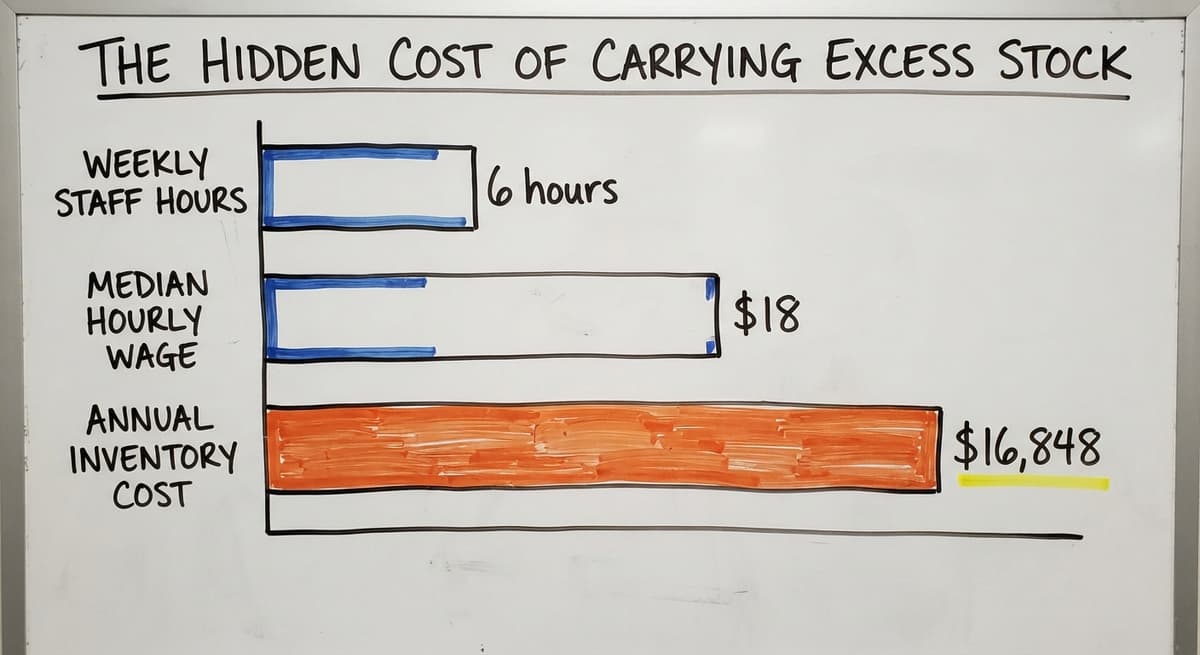
The Hidden Cost of Carrying Excess Stock
Carrying costs are the quiet drain most operators underestimate. Insurance, utilities, and labor tied to managing overstock add up fast. Consider a warehouse with 3 staff spending 6 hours a week managing slow-moving stock. The Bureau of Labor Statistics reports that stock clerks and order fillers earn a median wage near $18 an hour. That is roughly $16,848 a year spent managing inventory that should not be there.
GS1, the global standards body behind product barcodes, notes that "accurate spotting of products is the foundation of efficient supply chains", which means every item that cannot be scanned and traced adds friction to the very counts lean depends on.
What Are the Core Principles of Lean Inventory?
Lean inventory is built on 4 connected principles, and understanding each one helps you decide where to start.
- Demand-driven ordering means you buy based on what customers are actually buying, not what a forecast from last year said they might want.
- Just-in-time replenishment means stock arrives close to when you need it, so it moves quickly rather than sitting.
- Continuous improvement means you review what is working on a regular schedule and adjust reorder points, supplier terms, and stock levels as data changes.
- Waste elimination means you find every step or stock level that adds no value to the customer and remove it.
These principles work together. Demand-driven data feeds your reorder points. Reliable suppliers make just-in-time possible. Regular reviews surface the waste you missed last quarter. No single principle works well without the others.
The comparison is easier when one option is built for you
Off-the-shelf means fitting your process to the software. We do it the other way round, and the first look costs nothing.
Book a callHow Lean Inventory Differs From Traditional Inventory Management
Traditional inventory management favors large batch orders. The logic is sound: buy more, pay less per unit, and avoid the risk of running out. For businesses with predictable, high-volume demand and strong supplier discounts, that math often works.
Lean inventory flips the model. Smaller, more frequent orders tied to real demand signals replace the annual forecast and the bulk buy. Stock levels stay low. Cash stays free.
The honest trade-off is this: lean needs better data and more reliable suppliers. Traditional methods can survive on gut feel and a safety cushion. Lean cannot. If your supplier lead times swing by 2 weeks without warning, a lean model will leave you short.
Choosing the Right Model for Your Operation
Neither approach is right for every business. A distributor with 1 reliable supplier and steady weekly orders is a strong candidate for lean. A business with 40 vendors and seasonal demand spikes may need a hybrid: lean on core SKUs, traditional buffers on volatile ones.
The right model is the one that fits your actual demand pattern, not the one that sounds most efficient.

Key Metrics That Drive Lean Inventory Management
Four numbers tell you whether your inventory is lean or just thin. Track these before you change anything else.
- Inventory turnover rate measures how many times your total stock cycles through in a given period. A turnover of 12 means your average unit sits for about 1 month. Higher is generally better, but the right number depends on your product type and supplier terms.
- Days of supply on hand tells you how long your current stock would last at your current sales rate. Thirty days of supply on a product with a 5-day lead time means you are carrying 25 days of unnecessary stock.
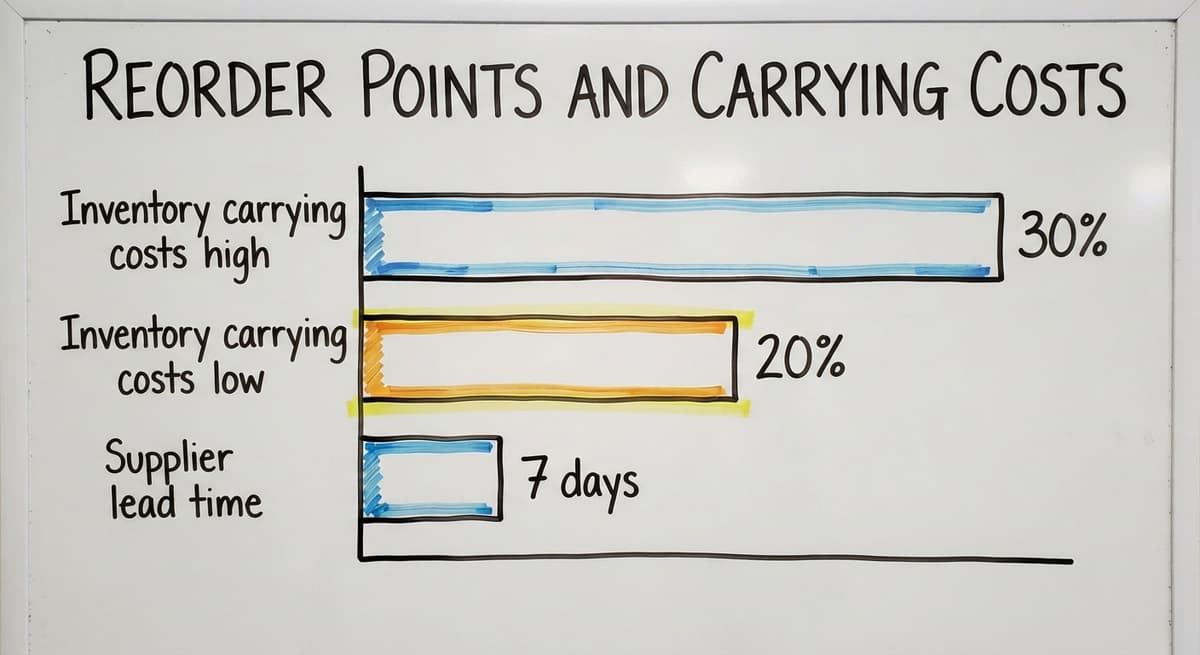
Reorder Points and Carrying Costs
- Reorder point is the stock level that triggers a new buy order automatically. Set it by adding your lead time demand to your safety stock. If a product sells 10 units a day and your supplier takes 7 days to deliver, your base reorder point is 70 units.
- Carrying cost as a percentage of inventory value captures the true annual cost of holding stock: storage, insurance, handling, and shrinkage. Most warehouses find this runs between 20% and 30% of inventory value once all costs are counted.
These metrics are not complex to calculate, but they do need current data. A spreadsheet updated once a month will not give you numbers you can act on.
See it running on your own process first
No build cost. The subscription starts once it is live and doing the job, not before.
Book a callCommon Challenges When Going Lean
Lean inventory management is practical, but it is not without risk. Three problems show up most often.
Demand spikes can cause stockouts if safety stock is cut too aggressively. A promotional event or an unexpected order can drain a lean warehouse in hours. Build a small, data-backed safety stock buffer for your highest-velocity SKUs rather than cutting to zero.
Supplier reliability is the hidden dependency. Lean breaks down when a vendor ships late or short without warning. Before tightening stock levels, audit your top suppliers for on-time delivery over the past 6 months.

Data Gaps and How to Start Lean Safely
Data gaps are the most common blocker. Teams running on spreadsheets and email rarely have the real-time inventory data lean needs. You cannot set an accurate reorder point from a count that is 3 weeks old.
Going lean is a process, not a switch. Start with your 10 highest-turnover SKUs and build the habit before expanding it across the catalog.
The Role of Software in Lean Inventory Management
Lean depends on accurate, real-time inventory data. A spreadsheet updated at the end of the week is not real-time data. It is a snapshot of what you had, not what you have.
Inventory management software automates the work that makes lean possible. It tracks stock levels as goods move in and out. It fires a reorder alert the moment a SKU hits its reorder point. It surfaces your turnover rate and days of supply without a manual calculation.
For small distributors already running their books through an accounting package, the right software connects to existing data rather than replacing the whole system. Replacing your accounting setup is a large project. Connecting a purpose-built inventory layer to it is not.
Fitting Software to Your Operation
Custom working software for small distributors can match the way your operation already runs. Staff do not need to learn a new workflow designed for a business twice your size. The system fits the process rather than forcing the process to fit the system.
Replacing spreadsheets in a warehouse operation does not have to mean a full enterprise rollout. It can mean one connected tool that keeps your counts current and your reorder points live.
Accurate data is what separates lean inventory from just running low on stock.
Not sure this is the right shape for your operation
Describe how the work runs today. We map it on a call and show you what it would look like built around that, before you spend anything.
Book a call
Steps to Start Implementing Lean Inventory
Moving toward lean inventory does not need a full system overhaul on day one. These 5 steps give you a place to start.
- Audit current stock levels and flag every SKU that has not moved in 90 days. That is your dead stock. It is costing you space and cash right now.
- Map your actual demand patterns using 6 to 12 months of sales history. Look for which SKUs move steadily, which are seasonal, and which are unpredictable.
- Set data-backed reorder points for your top 10 to 20 moving SKUs. Use lead time plus a small safety buffer. Do not guess.
Suppliers, Systems, and Scaling Lean
- Tighten communication with key suppliers on lead times. Ask for written commitments. Know which vendors you can rely on and which ones need a larger buffer.
- Put a system in place that keeps your data current. Whether that is inventory management software for wholesale distributors or a tighter spreadsheet discipline, the data must be live enough to act on.
Start narrow and expand. Trying to go lean across 500 SKUs at once is how the project stalls. Prove the model on a small slice first.
Is Lean Inventory Management Right for Your Business?
Lean inventory management works best when demand is reasonably predictable and supplier lead times are consistent. If those 2 conditions are true for most of your product line, lean will save you money.
Small and mid-size distributors and warehouses often benefit the most. Every dollar tied up in excess inventory is a dollar that cannot fund growth. At smaller scale, that math is sharper.
If your operation still runs on spreadsheets and email, the first step is not overhauling everything at once. The first step is getting reliable data on your top-moving SKUs. From there, lean principles become practical rather than theoretical.
Getting Started With a System Built for Your Operation
How custom warehouse software works with your existing accounting package is a question worth asking early. A connected system that sits on top of what you already use can give you real-time stock levels, automated reorder alerts, and the metrics lean needs, without a months-long rollout.
If you are ready to stop managing inventory by instinct and start managing it by data, a custom workflow built around your actual operation is the practical next step. Describe what your current process looks like, and a system can be built to fit it.
Frequently asked questions
What is lean management in simple words?
Lean management means cutting waste from your operation so that every step, every dollar, and every resource adds value to the customer. In inventory terms, that means holding only the stock you need, ordering based on real demand, and removing any cost that does not help you serve the customer faster or better.
What are the 5 principles of lean?
The 5 lean principles are: define value from the customer's point of view, map the steps that deliver that value, make those steps flow without interruption, let customer demand pull work through the system, and continuously improve. Applied to inventory, these translate to stocking what customers buy, ordering when stock is actually needed, and regularly reviewing whether your levels and processes still make sense.
What are the three types of inventory management?
The three broad types are just-in-time (ordering stock to arrive close to when it is needed), periodic review (checking stock levels on a set schedule and ordering up to a target), and continuous review (monitoring stock levels in real time and reordering automatically when a threshold is hit). Lean inventory management aligns most closely with continuous review and just-in-time principles.
What are the top 5 lean tools?
The 5 tools most commonly used in lean inventory are: 5S (organizing the physical workspace so stock is easy to find and count), kanban (a visual signal that triggers replenishment when stock reaches a set level), value stream mapping (tracing every step a product takes from order to delivery), root cause analysis (finding why a problem keeps happening rather than patching the symptom), and standard work (documenting the best current process so every team member follows the same steps).
What does excess inventory actually cost a distribution or warehouse operation?
Excess inventory costs money in at least 4 ways: cash tied up in stock that is not selling, warehouse space occupied by slow-moving product, labor spent counting and moving goods that are not generating revenue, and the risk of spoilage or obsolescence if the product ages out. Carrying costs, which include insurance, storage, and handling, usually run between 20% and 30% of inventory value per year for most warehouse operations.
Is lean inventory management practical for a business still running on a basic accounting package and spreadsheets?
Yes, but you need to close the data gap first. Lean needs current stock counts and reliable reorder signals. Spreadsheets updated weekly cannot provide that. The practical path is to connect a purpose-built inventory layer to your existing accounting setup rather than replacing it. That gives you real-time stock levels and automated reorder alerts without a full system overhaul.
How can a small distributor start moving toward lean inventory without a big system overhaul?
Start with your 10 to 20 highest-turnover SKUs. Audit how much stock you are holding versus how much you actually need based on lead time and sales rate. Set a reorder point for each one. Confirm lead times with your top suppliers. Then put a system in place, whether software or a tighter process, that keeps those counts current. Expand to the rest of your catalog once the model is working on the core items.
Start with a free first look
A 30 minute call, your operation mapped, and a clear picture of what we would build. No obligation and nothing to install.
Book a callRelated guides
The rest of this guide, for the parts of the job this page does not cover.
- What is the Difference Between Aggregate and Item Inventory Management
- What is Jit Inventory Management
- What is Kanban System of Inventory Management
- What is the Definition of Inventory Management
- What is an Important Factor in Inventory Management
- What is Abc Classification in Inventory Management
- What is Inventory Management in Working Capital
- What is Poor Inventory Management
- What is Inventory Management and Its Types
- What is the Main Purpose of Inventory Management
- What is Inventory Management in Pharmacy
- What is Effective Inventory Management
- What is Information Technology Inventory Management
- What is Risk Pooling in Inventory Management
- What is Inventory Management Mary Kay
- What is Stock Taking in Inventory Management
- What is Hospital Inventory Management
- What is Bin Number in Inventory Management
- What is the Scope of Inventory Management
- What is the Goal of Inventory Management Quizlet
- What is the Implication of Proper Inventory Management
- What is Omni-channel Inventory Management
- What is Inventory Management and Its Importance
- What is the Importance of Eoq in Inventory Management