

What Is Scrap In Inventory Management
Scrap costs money twice: once when you bought the inventory, and again when it sits in your system as stock that cannot fill an order. For wholesale distributors and warehouse operators running on spreadsheets and an accounting package, scrap is often the gap between what the system says and what is actually on the shelf.
Reviewed October 2026.
The obligation behind all of this is not optional. IRS Publication 538 states: “To figure taxable income, you must value your inventory at the beginning and end of each tax year.” A figure nobody trusts makes that number a guess.
This guide explains what scrap is, how to tell it apart from related inventory problems, and what good tracking looks like without a six-figure ERP.
Book a callWhat Scrap in Inventory Management Actually Means
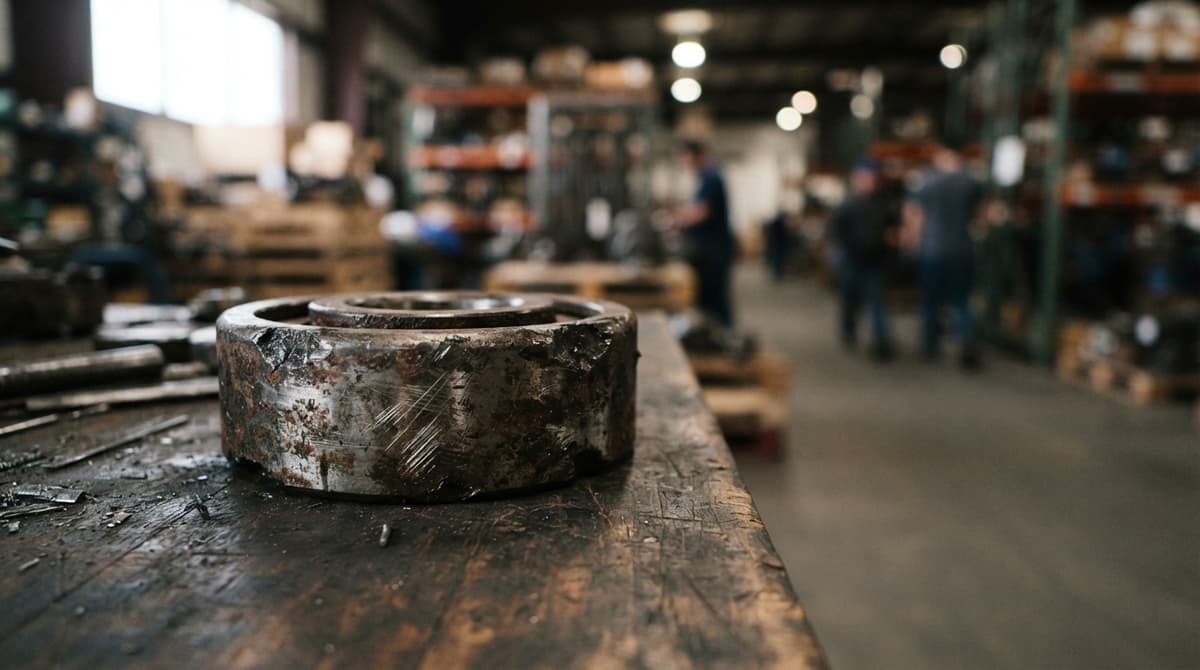
Scrap is inventory that can no longer be sold, used, or returned in its original form. Damaged goods, broken components, expired products, and unusable raw materials all qualify. The key distinction from waste is recovery value: scrap can often be sold for salvage or recycled, while waste is discarded with nothing coming back. In distribution and warehousing, scrap frequently goes untracked until it becomes visible, which is exactly when it has already done its damage to your books and your inventory accuracy.
We build it for your operation, and the first look is free
If you would rather not compare products, describe how your operation already works and we build the system around it.
No build cost. You see it running on your own process first, and the monthly subscription starts only once it is live.
Book a callCommon Types of Scrap Found in Warehouses
Scrap shows up in more places than most operators expect. The categories below cover the most frequent sources in wholesale and distribution environments.
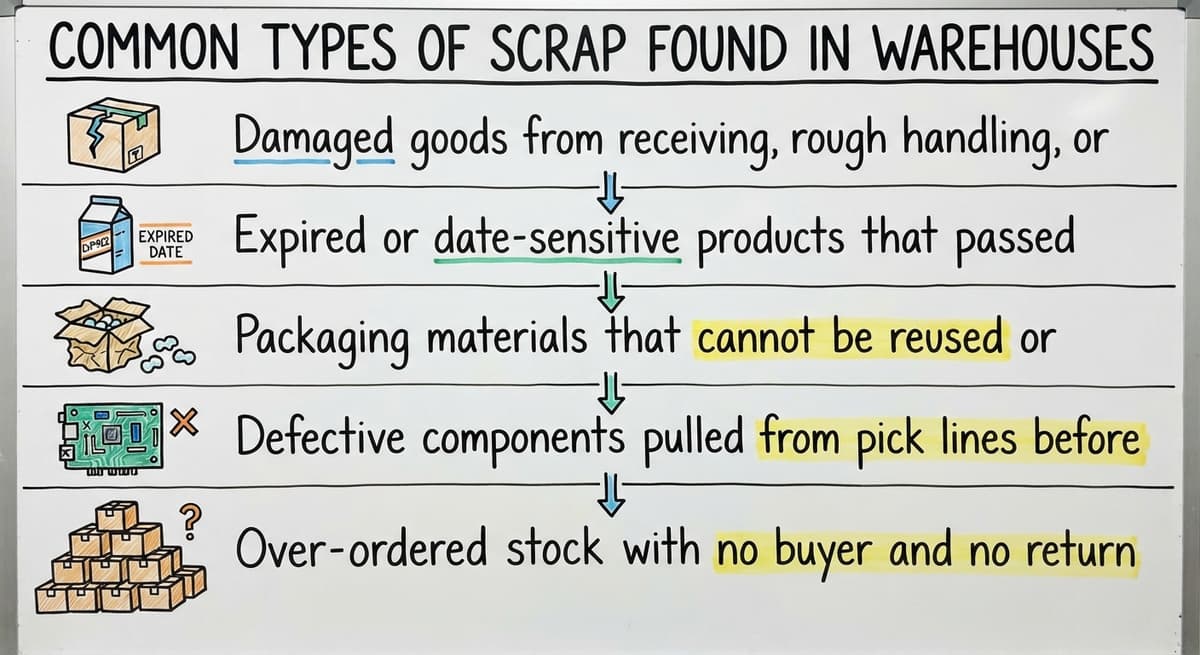
- Damaged goods from receiving, rough handling, or improper storage
- Expired or date-sensitive products that passed their sell-by window before moving
- Packaging materials that cannot be reused or returned to a supplier
- Defective components pulled from pick lines before an order ships
- Over-ordered stock with no buyer and no return path available
Tracking these items consistently depends on reliable product spotting. As GS1 notes in its barcode standards records, accurate item-level data is the foundation of any inventory control process, you can read their standards at gs1.org/standards/barcodes. Without that foundation, scrap recording becomes guesswork.
How Is Scrap Different From Shrinkage, Waste, and Obsolete Inventory?
Scrap, shrinkage, waste, and obsolete inventory describe four separate problems, and mixing them up produces inaccurate books and poor purchasing decisions. Scrap is a known, documented event. Shrinkage covers theft and unexplained loss where no record exists. Waste is material discarded with zero recovery value, while scrap may still be sold or recycled. Obsolete inventory is physically intact but has no current demand.
Each category belongs in its own tracking code or general ledger account. When they get lumped together, you lose the ability to see which problem is actually growing. A spike in scrap looks very different from a spike in shrinkage, and the fix for each is different.
| Category | Physical Condition | Recovery Value | Cause Known? |
|---|---|---|---|
| Scrap | Damaged or unusable | Sometimes | Yes |
| Waste | Discarded | None | Yes |
| Shrinkage | Unknown or missing | Unknown | No |
| Obsolete inventory | Intact | Low or none | Yes |
The comparison is easier when one option is built for you
Off-the-shelf means fitting your process to the software. We do it the other way round, and the first look costs nothing.
Book a callWhy Scrap Hurts Your Bottom Line
Every scrapped unit is a cost already paid with no revenue to offset it. Untracked scrap inflates your cost of goods sold and shrinks your margins without any obvious signal until month-end, when the numbers do not add up.
The deeper problem is phantom inventory: your system shows stock that is not physically there. Phantom inventory leads to orders that cannot be filled, customer complaints, and emergency buys at poor prices. Across high-volume SKUs, even a small scrap rate compounds quickly. A 2% scrap rate on a SKU you turn 500 units a month means 10 units lost every month, and if they stay in the system, they will cause a missed order eventually.

How Scrap Is Recorded and What the Record Should Contain
A scrap transaction does two things: it removes units from on-hand quantity and posts the cost to a scrap or loss account. The record should capture the date, SKU, quantity, reason code, and the name of the person who identified the problem. Reason codes such as "damage," "expiration," and "defect" let you analyze patterns over time rather than treating every loss as a one-off event.
Without a formal scrap record, the inventory count drifts away from reality. An accounting package can hold the financial entry, but the working detail, including the reason and the location, usually needs to live in a separate operations system that feeds the financial post automatically. Reducing phantom inventory in a warehouse starts with capturing this data at the moment of discovery, not at month-end.
The Most Common Causes of Scrap in Small and Mid-Size Operations
Most scrap in smaller operations traces back to process gaps rather than bad luck. These are the causes that appear most often.
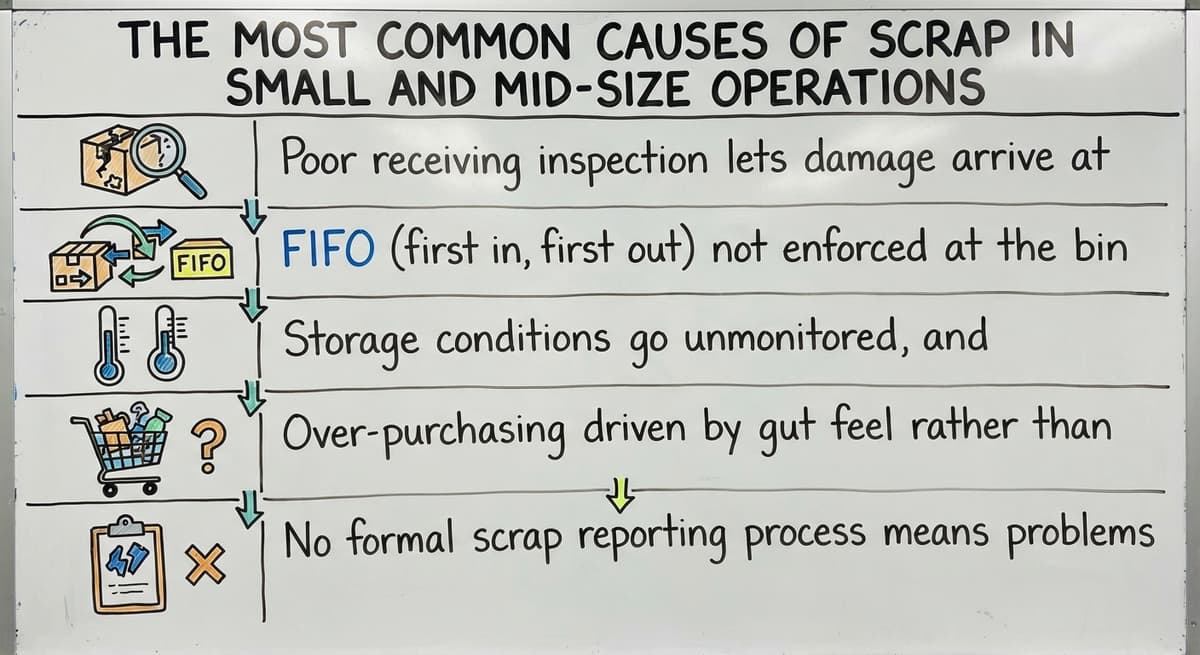
- Poor receiving inspection lets damage arrive at the dock without being caught or recorded
- FIFO (first in, first out) not enforced at the bin level means older stock gets buried behind newer arrivals and expires before it ships
- Storage conditions go unmonitored, and temperature, humidity, or stacking weight causes damage over time
- Over-purchasing driven by gut feel rather than demand data creates stock with no buyer
- No formal scrap reporting process means problems go unrecorded and the same issues repeat
FIFO inventory management for distributors is one of the highest-use fixes available because it addresses both expiration and damage risk at the same time.

How to Track and Reduce Scrap Without a Large ERP
A simple scrap log beats nothing: date, item, quantity, and reason in a spreadsheet is a real starting point. Add reason codes so you can spot which SKUs or processes generate the most scrap, and review totals weekly rather than quarterly. Patterns surface much faster on a weekly cadence.
Enforce FIFO at the bin level so the oldest stock always moves first. Post a physical label or use a bin location system that makes the sequence obvious to anyone picking.
See it running on your own process first
No build cost. The subscription starts once it is live and doing the job, not before.
Book a callWhen to Move Scrap Tracking Beyond a Spreadsheet
For operations that have outgrown the spreadsheet, inventory management software for small distributors can automate scrap recording at the point of discovery. How custom inventory software works with your accounting platform matters here: the goal is a system that captures the working detail and posts the financial entry without requiring a second data-entry step. The measure of a good scrap tracking setup is whether the inventory count and the physical count match at the end of every week, not just at year-end.

Is Manual Scrap Tracking Still Enough for Your Operation?
Manual tracking works at low volume, but it breaks down as SKU counts and team size grow. Spreadsheets and paper logs stop being reliable when inventory counts are frequently wrong, scrap costs are a surprise at month-end, or staff skip the log because it slows them down. Those three signs together mean the process has already failed.

How a Structured Operations System Closes the Scrap Tracking Gap
A structured operations system built around your existing workflow can add scrap recording without a disruptive migration. The objective is accurate inventory data that feeds your accounting package automatically, not a new financial system. Inventory accuracy and cycle counting become much easier when every scrap event is recorded at the moment it happens, with a reason code attached, rather than reconstructed from memory at the end of the month.
If any of those warning signs sound familiar, the right next step is a clear look at how your current workflow captures, or fails to capture, scrap events. A connected operations system can close that gap without replacing the tools your team already knows.
Frequently asked questions
What is a scrap item?
A scrap item is a unit of inventory that can no longer be sold, used, or returned in its original condition. It may be damaged, expired, defective, or simply unusable. Unlike waste, a scrap item sometimes has recovery value and can be sold for salvage or recycled.
How to account for inventory in accounting?
Inventory is recorded as an asset on the balance sheet at its buy cost. When inventory is sold, the cost moves to cost of goods sold on the income statement. When inventory is scrapped, the cost is removed from the asset account and posted to a scrap or loss account, reducing profit by the amount of the loss.
What is the 80/20 rule in inventory?
The 80/20 rule in inventory, also called the Pareto principle, holds that roughly 80% of your revenue or activity comes from about 20% of your SKUs. In scrap tracking, the same pattern often applies: a small number of items or processes generate most of your scrap losses. Identifying that 20% is where reduction efforts pay off fastest.
What is an acceptable scrap rate in manufacturing?
There is no single acceptable scrap rate that applies across industries. Rates vary widely based on the product, process, and materials involved. In distribution rather than manufacturing, the more useful benchmark is whether your scrap rate is trending up or down over time. A rate that is small but rising is a bigger concern than a stable rate that is slightly higher.
Why does untracked scrap cause inventory errors?
When a scrapped item is not recorded, the system still counts it as available stock. That creates phantom inventory: units the system believes exist but that cannot be picked or shipped. Phantom inventory leads to missed orders and inaccurate purchasing decisions because the system signals there is enough stock when there is not.
What information should a scrap record include?
A complete scrap record should capture the date the item was identified, the SKU or item number, the quantity scrapped, a reason code such as damage or expiration, and the name of the person who flagged it. That combination lets you analyze patterns by item, location, and cause rather than treating each loss as an isolated event.
How does scrap differ from obsolete inventory?
Scrap is physically damaged or unusable and cannot be sold in its current condition. Obsolete inventory is physically intact but has no current buyer or demand. Both reduce the value of your inventory, but they need different responses: scrap needs to be removed from the count at once, while obsolete inventory may be discounted, returned, or liquidated over time.
Start with a free first look
A 30 minute call, your operation mapped, and a clear picture of what we would build. No obligation and nothing to install.
Book a callRelated guides
The rest of this guide, for the parts of the job this page does not cover.
- What is the Difference Between Aggregate and Item Inventory Management
- What is Jit Inventory Management
- What is Kanban System of Inventory Management
- What is the Definition of Inventory Management
- What is an Important Factor in Inventory Management
- What is Abc Classification in Inventory Management
- What is Inventory Management in Working Capital
- What is Poor Inventory Management
- What is Inventory Management and Its Types
- What is the Main Purpose of Inventory Management
- What is Inventory Management in Pharmacy
- What is Effective Inventory Management
- What is Information Technology Inventory Management
- What is Risk Pooling in Inventory Management
- What is Inventory Management Mary Kay
- What is Stock Taking in Inventory Management
- What is Hospital Inventory Management
- What is Bin Number in Inventory Management
- What is the Scope of Inventory Management
- What is the Goal of Inventory Management Quizlet
- What is the Implication of Proper Inventory Management
- What is Omni-channel Inventory Management
- What is Inventory Management and Its Importance
- What is the Importance of Eoq in Inventory Management