

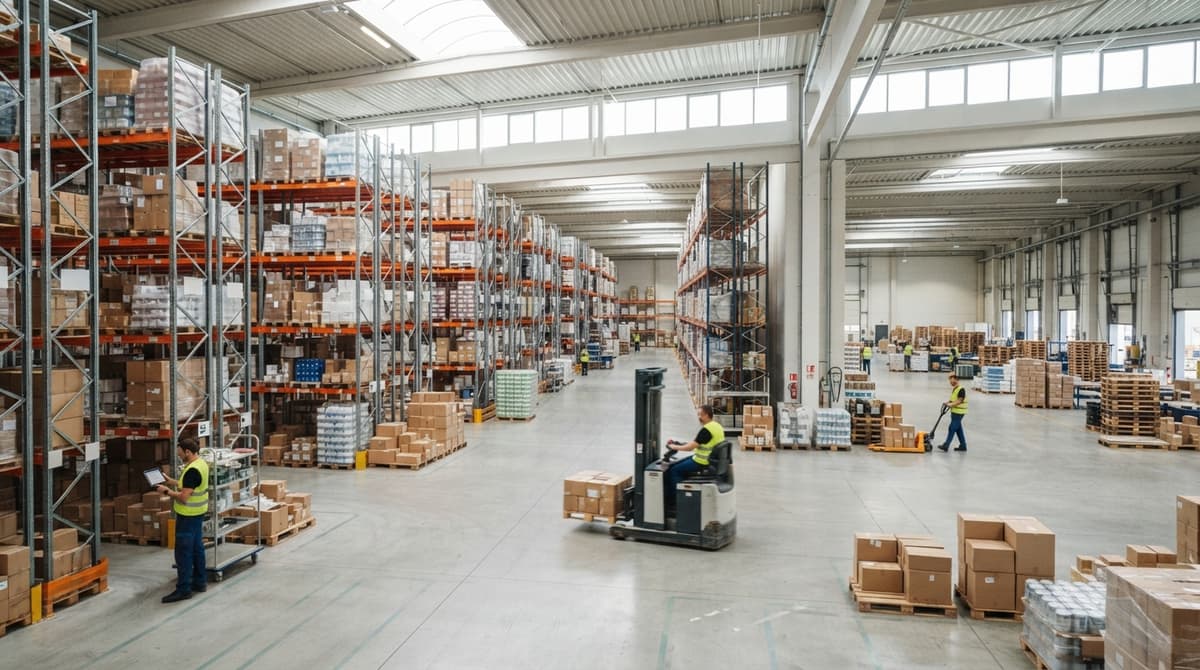
What Is The Concept Of Inventory Management
Inventory management means knowing what stock you have, where it sits, and when to order more. It covers every step from receiving a shipment to shipping a customer order. The goal is simple: have the right product in the right place at the right time, without locking up cash in goods that sit too long. Reviewed and updated: October 2026.
Book a callThe Core Idea Behind Inventory Management
At its core, inventory management is the practice of tracking stock through its full life cycle inside your operation. A product arrives at your dock, gets counted and logged, moves to a storage bin, gets pulled for an order, and ships. Every step in that chain is inventory management.
The goal is balance. Too little stock and you lose sales. Too much and your cash is sitting on a shelf. Good inventory control keeps that balance without requiring your team to count everything by hand every day. It gives you a live picture of what you own, where it is, and what you need to buy next.
We build it for your operation, and the first look is free
If you would rather not compare products, describe how your operation already works and we build the system around it.
No build cost. You see it running on your own process first, and the monthly subscription starts only once it is live.
Book a callWhy Inventory Management Matters for Wholesalers and Distributors
For wholesale and distribution businesses, the stakes are real and immediate. A stockout does not just mean a lost sale. It means a customer calls your competitor, and they may not come back. Overstock is just as costly: cash tied up in slow-moving goods cannot pay for labor, freight, or new product lines.
Poor visibility into stock levels leads to double orders, misplaced items, and fulfillment errors that damage your reputation. GS1, the global standards body behind barcodes, notes that accurate barcode spotting is the foundation of supply chain visibility, because a scan-based count removes the guesswork that causes most receiving errors. The US Census Bureau tracks wholesale inventories monthly, and the data consistently shows that inventory-to-sales ratios swing with market conditions, meaning your margin for error is thin.
Getting this right protects your cash, your shelf space, and your customer relationships.
What Are the Main Parts of an Inventory Management System?
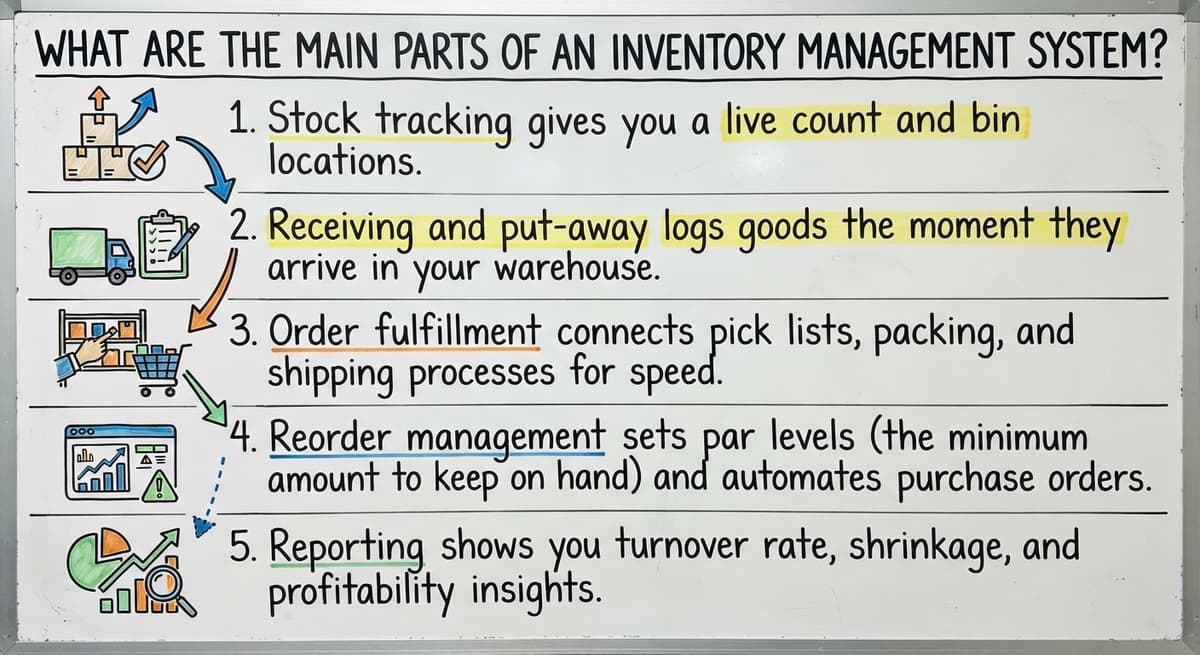
An inventory management system has 5 core components, each one covering a distinct stage of the stock cycle. Miss any one of them and the whole picture breaks down.
- Stock tracking gives you a live count and bin location for every SKU (stock-keeping unit, the unique code for each product you carry).
- Receiving and put-away logs goods the moment they arrive, so your counts are accurate from day one.
- Order fulfillment connects pick lists, packing, and shipping into one tracked workflow so orders go out right the first time.
- Reorder management sets par levels (the minimum quantity you want on hand) and triggers a buy order before you run out.
- Reporting shows you turnover rate, shrinkage (stock lost to damage or theft), and carrying costs (the expense of holding inventory over time).
How the 5 Parts Work as a Loop
These 5 parts work as a loop, not a list. Data from shipping feeds back into stock counts, which feeds into reorder decisions, which shapes what you receive next week.
The comparison is easier when one option is built for you
Off-the-shelf means fitting your process to the software. We do it the other way round, and the first look costs nothing.
Book a callCommon Inventory Management Methods
Several methods exist for deciding which units ship first and how to value what remains. Each one fits a different kind of operation.
FIFO (first in, first out) means the oldest stock ships first. If you received a pallet in March and another in April, the March pallet goes out first. This is critical for perishables, dated goods, and anything with a shelf life.
LIFO (last in, first out) does the opposite: the newest stock ships first. It is rarely used in warehouse operations but appears in specific cost accounting situations where rising prices affect taxable income. The IRS notes in Publication 538 that "to figure taxable income, you must value your inventory at the beginning and end of each tax year," which is why the method you choose has real financial consequences.
Just-in-Time Ordering and ABC Analysis
Just-in-time ordering means you buy only what you need, when you need it. It cuts carrying costs but needs reliable suppliers.
ABC analysis ranks your SKUs by value and sales velocity. Your top 10% of products by revenue get the most attention; your slowest movers get less. This keeps your team focused where it counts.

How Inventory Management Fits Into Daily Operations
Picture a typical morning at a mid-size distributor. A truck arrives with 3 pallets. Someone counts the boxes, checks them against the buy order, and logs them into the system. Each item gets a bin location. By noon, a customer order comes in. A picker pulls the items from those bins, packs the box, and hands it to shipping. The system updates the count automatically.
What Happens When the Steps Are Not Connected
That flow works cleanly when every step is connected. When it is not, gaps appear fast. A paper receiving log sits on a clipboard for 2 days before anyone keys it in. A pick list printed at 8 a.m. does not reflect a return that came in at 9. An emailed buy order never gets confirmed, so the reorder happens twice.
Inventory management connects purchasing, warehousing, and customer service into one flow. A gap in any stage creates errors downstream, and those errors cost time, money, and customer trust.
See it running on your own process first
No build cost. The subscription starts once it is live and doing the job, not before.
Book a call
Where Spreadsheets and General Accounting Software Fall Short
Your accounting software is built for accounting. It tracks the financial value of your inventory, which matters for your books and your taxes. What it does not track is bin locations, lot numbers, or real-time quantities as picks happen on the floor. That is not a flaw in the software. It is simply not what it was designed to do.
Spreadsheets have a different problem. An Excel file is accurate at the moment someone saves it. The next pick, the next receiving slip, the next return makes it wrong. When 3 people share the same file across a network drive, version conflicts are almost guaranteed.
When Low-Volume Tools Stop Working
These tools work fine at low volume. A business carrying 50 SKUs and shipping 20 orders a day can manage with them. As SKU counts climb past a few hundred and order volume grows, manual processes multiply errors faster than staff can correct them. The NIST Manufacturing Extension Partnership consistently points to process gaps, not technology gaps, as the primary source of supply chain errors in small and mid-size operations.

What Good Inventory Management Software Actually Does
The right inventory management software does not replace your team. It removes the manual steps that slow them down and cause mistakes.
Here is what a purpose-built system handles day to day:
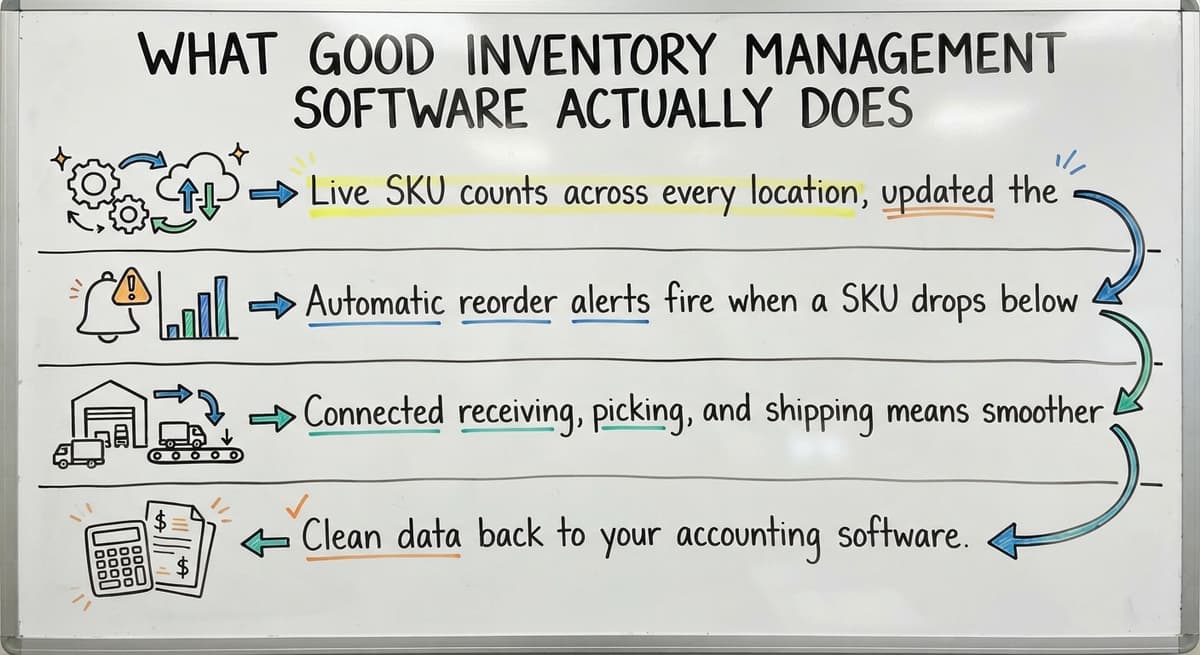
- Live SKU counts across every location, updated the moment a pick or receipt is logged, so any team member can answer a stock question without walking the floor.
- Automatic reorder alerts fire when a SKU drops below the par level your team sets, so reorders happen on time, not late.
- Connected receiving, picking, and shipping means one scan logs a receipt, another confirms a pick, and a third closes the shipment. No paper in between.
- Clean data back to your accounting software without duplicate entry, so your accounting stays accurate without anyone manually reconciling two systems.
What Manual Reconciliation Actually Costs
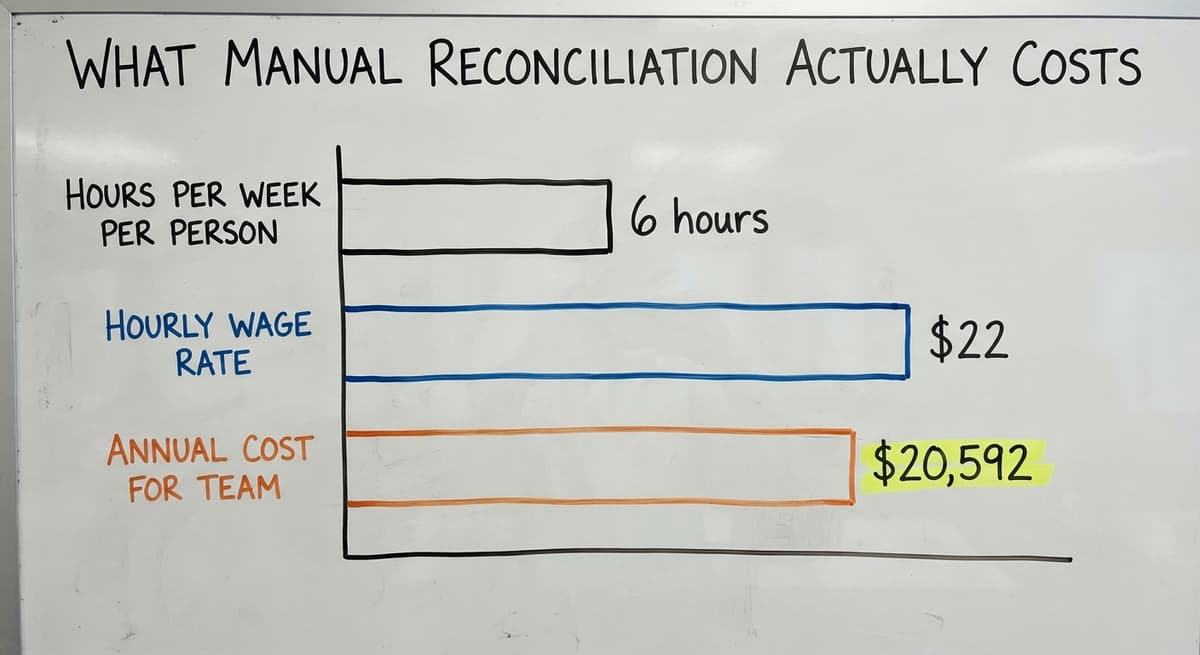
For a team of 3 people spending 6 hours a week each on manual count matching at $22 an hour (a common rate for warehouse staff, per the Bureau of Labor Statistics), that is roughly $20,592 a year in labor applied to a problem software can largely solve. The math changes fast when you price a solution against that baseline.
Not sure this is the right shape for your operation
Describe how the work runs today. We map it on a call and show you what it would look like built around that, before you spend anything.
Book a call
Signs Your Operation Has Outgrown Manual Inventory Tracking
Some of these will feel familiar. That is the point.
- Orders ship wrong or late because the pick list was printed before a return came in or a bin was restocked.
- Your team spends hours reconciling counts instead of filling orders, and the counts are still not right by end of day.
- A manager cannot answer "how much of SKU X do we have right now" without walking to the shelf or calling someone on the floor.
- Reorders happen too late, and you scramble to cover a stockout, or too early, and a pallet sits for 90 days eating warehouse space.
- Receiving takes twice as long as it should because someone is hand-keying quantities from a paper slip into a spreadsheet.
When the Workarounds Become the Work
None of these are signs of a bad team. They are signs that the tools have not kept pace with the volume. When the workarounds take longer than the actual work, the system has already failed.
Can I Improve Inventory Management Without a Long, Expensive Implementation?
Yes, and the right approach starts by mapping to how your operation already runs, not by forcing a new process on your team. You do not need an ERP system or a months-long rollout to fix the gaps described above.
Your accounting software stays in place for accounting. A purpose-built working layer sits alongside it, handling the warehouse side: receiving, bin tracking, pick lists, and reorder triggers. The 2 systems share data cleanly, so your books stay accurate without manual matching.

How a Local Implementation Partner Makes the Difference
A local rollout partner who works with small and mid-size distributors can build around your real workflows. They ask how your team actually receives a shipment, how orders get picked, and where the current process breaks. Then they configure the system to match that reality, not a textbook diagram.
If you are curious about how inventory management software works for small distributors, or whether accounting software integration for warehouse operations is the right fit for your setup, the next step is a straightforward conversation about your current process. A good partner will tell you honestly whether a change is worth it before you spend anything.
Frequently asked questions
What does inventory management mean in simple terms?
Inventory management means knowing what stock you have, where it is, and when to order more. It covers everything from the moment goods arrive at your dock to the moment an order ships to your customer.
Why is inventory management important for wholesalers and distributors?
A stockout costs you a sale and risks losing the customer for good. Overstock ties up cash and warehouse space. Poor visibility causes fulfillment errors that damage your reputation. For wholesale distribution, getting inventory control right is directly tied to revenue and customer trust.
What is the difference between FIFO and LIFO inventory methods?
FIFO (first in, first out) ships the oldest stock first. It is the standard for most distributors, especially those handling perishables or dated goods. LIFO (last in, first out) ships the newest stock first and is used mainly in specific accounting situations. Most warehouse operations run FIFO.
Why is general accounting software not enough for warehouse inventory management?
Your accounting software tracks the financial value of your inventory for accounting purposes. It does not track bin locations, lot numbers, or real-time quantities as picks happen. It was built for accounting, not warehouse operations. Pairing it with a purpose-built working system gives you both.
What does inventory management software actually do day to day?
It gives your team a live count of every SKU, fires reorder alerts when stock drops below your set threshold, connects receiving and shipping into one tracked workflow, and feeds accurate data back to your accounting package without manual entry.
How do I know if my operation has outgrown spreadsheet-based inventory tracking?
If orders are shipping wrong, your team spends more time counting than picking, managers cannot answer basic stock questions without walking the floor, or reorders are consistently too late or too early, your operation has outgrown manual tracking.
Can I improve inventory management without replacing my accounting software?
Yes. The right inventory management software works alongside your accounting software rather than replacing it. Your accounting software handles the accounting layer. The new system handles the working layer: receiving, bin tracking, picking, and reorder triggers. Data flows between them without duplicate entry.
What are carrying costs in inventory management?
Carrying costs are the ongoing expenses of holding inventory: warehouse space, insurance, labor to manage the stock, and the cost of cash tied up in goods sitting on shelves. Reducing carrying costs is one of the main financial benefits of tighter inventory control.
Start with a free first look
A 30 minute call, your operation mapped, and a clear picture of what we would build. No obligation and nothing to install.
Book a callRelated guides
The rest of this guide, for the parts of the job this page does not cover.
- What is the Difference Between Aggregate and Item Inventory Management
- What is Jit Inventory Management
- What is Kanban System of Inventory Management
- What is the Definition of Inventory Management
- What is an Important Factor in Inventory Management
- What is Abc Classification in Inventory Management
- What is Inventory Management in Working Capital
- What is Poor Inventory Management
- What is Inventory Management and Its Types
- What is the Main Purpose of Inventory Management
- What is Inventory Management in Pharmacy
- What is Effective Inventory Management
- What is Information Technology Inventory Management
- What is Risk Pooling in Inventory Management
- What is Inventory Management Mary Kay
- What is Stock Taking in Inventory Management
- What is Bin Number in Inventory Management
- What is the Goal of Inventory Management Quizlet
- What is the Implication of Proper Inventory Management
- What is Omni-channel Inventory Management
- What is Inventory Management and Its Importance
- What is the Importance of Eoq in Inventory Management
- What is the Importance of Quality Inventory Management
- What is Inventory Management in Restaurant