


What Is Telecom Inventory Management
Telecom inventory management is the process of tracking, organizing, and controlling telecom assets from the moment they arrive at a warehouse to the moment they ship to a customer. It covers phones, SIM cards, routers, cables, and accessories. It differs from general inventory management because telecom goods carry unique identifiers, lose value fast, and are easy to lose physically.
Reviewed and updated: October 2026
Book a callTelecom Inventory Management Defined
Telecom inventory management means knowing exactly what you have, where it is, and what condition it is in, for every telecom item in your operation. That sounds simple. In practice, it is not.
General inventory tracks a box of bolts by quantity. Telecom inventory tracks a phone by its IMEI, which is a unique 15-digit number that identifies that specific device, the way a VIN identifies a car. A SIM card carries an ICCID, a 19- or 20-digit number tied to that card alone. These identifiers change how you receive, store, pick, and ship. They also change what happens when something goes missing.
Short product cycles, carrier-specific SKUs, and high unit value in a small physical package make telecom goods harder to manage than most warehouse categories.
We build it for your operation, and the first look is free
If you would rather not compare products, describe how your operation already works and we build the system around it.
No build cost. You see it running on your own process first, and the monthly subscription starts only once it is live.
Book a callWhat Gets Tracked in Telecom Inventory
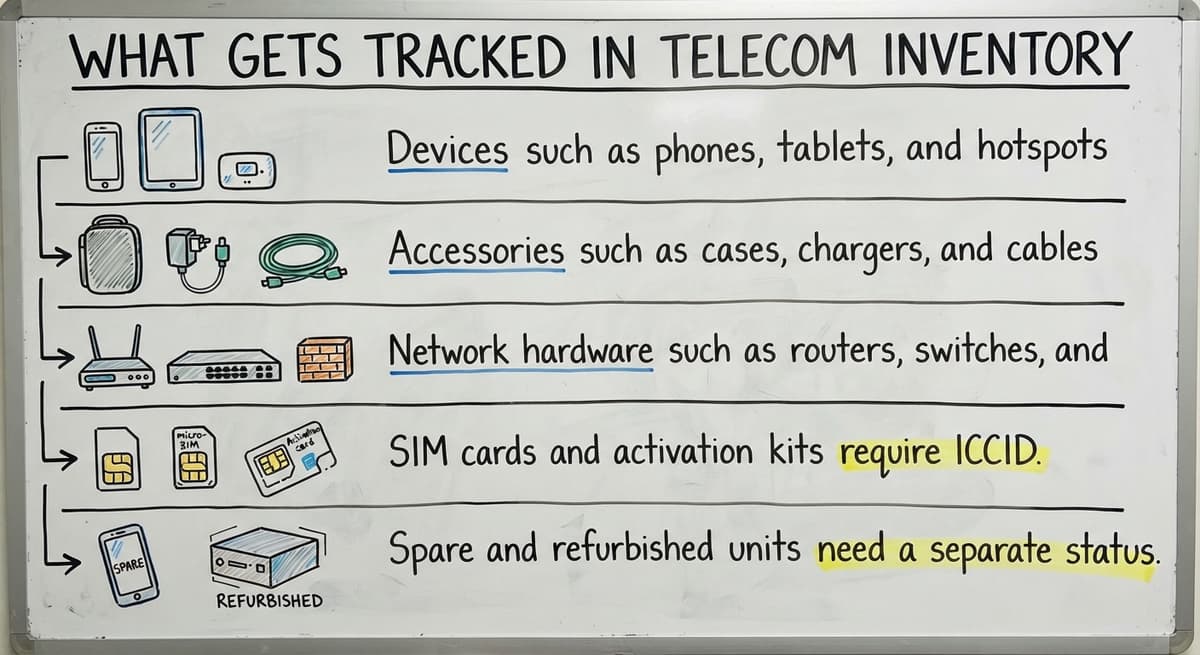
A telecom wholesale distributor usually handles 5 main asset categories, and each one needs its own tracking rules.
- Devices such as phones, tablets, and hotspots need IMEI tracking so each unit has a unique identity from receipt to sale.
- Accessories such as cases, chargers, and cables are tracked by SKU and quantity, but must be matched to the correct device model.
- Network hardware such as routers, switches, and modems often carry serial numbers and may have firmware versions that matter to the customer.
- SIM cards and activation kits need ICCID tracking because each card is tied to a specific carrier plan and activation state.
- Spare and refurbished units need a separate status flag so they never ship as new.
Why SKU Complexity Multiplies Fast in Telecom Distribution
Wholesale distributors who carry multiple carrier lines at once multiply SKU complexity fast. A single phone model may exist as 5 or more SKUs across different carriers, storage sizes, and colors. As GS1 notes, the barcode standards that govern scan-based counting are designed to handle exactly this kind of unique item spotting, and their full framework is documented at gs1.org/standards/barcodes. Skipping that level of detail at receiving is where most errors start.
Why Is Telecom Inventory Harder to Manage Than General Goods?
Telecom inventory is harder to manage than general goods because the items are small, expensive, and tied to business rules that change by carrier and program. A pallet of routers looks manageable until you realize each unit has a serial number, a firmware state, and a carrier unlock status that all affect whether it can ship to a given customer.
Short product cycles mean a flagship device from last quarter may already be a closeout this quarter. SKUs turn over fast, and old part numbers linger in spreadsheets long after the product is gone.
The comparison is easier when one option is built for you
Off-the-shelf means fitting your process to the software. We do it the other way round, and the first look costs nothing.
Book a call
Why High Unit Value and Carrier Rules Make Telecom Inventory Uniquely Risky
High unit value in a small form factor creates real shrinkage risk. A handful of SIM cards worth several hundred dollars can leave a warehouse with no paper trail if receiving and shipping are not scan-verified.
Carrier rebate programs and activation requirements tie inventory status to financial outcomes. A unit that counts as "in stock" may not be eligible to ship under a specific carrier program, which a simple quantity count will never reveal.
Spreadsheets and email threads cannot hold these rules. A telecom distributor running on manual processes is not just inefficient, it is exposed.
Core Functions of a Telecom Inventory Management System
A purpose-built inventory management system for telecom distribution handles more than stock counts. These are the functions that matter most.
- Serial and IMEI-level tracking gives every unit a unique identity from the moment it arrives, so you can answer questions like "which customer received unit 123456789" in seconds.
- Real-time stock visibility across locations means a sales rep in one office and a picker in a warehouse 50 miles away see the same number at the same time.
- Receiving and put-away workflows with scan check catch quantity discrepancies and wrong-model deliveries at the dock, not at month-end when the damage is done.
- Outbound pick-and-pack scanning confirms the correct IMEI ships to the correct order, which removes the wrong-device shipment problem that generates costly returns.
- Reorder alerts tied to actual movement data replace gut-feel purchasing with signals based on how fast each SKU actually sells.

Why Accurate Inventory Records Matter for Tax Valuation
These 5 functions together create the foundation for tight inventory control without requiring a large enterprise system. The IRS is direct on why this discipline matters financially: IRS Publication 538 states, "To figure taxable income, you must value your inventory at the beginning and end of each tax year." Accurate unit-level records make that valuation defensible.
How Telecom Inventory Management Connects to Your Other Operations
Good inventory data does not live in a silo. It feeds purchasing, order fulfillment, and financial reporting at the same time.
For operations already using an accounting platform, the inventory layer should handle the detail and let the accounting platform handle the books. When a shipment is received and scanned, the cost should post to your accounting software automatically. When an order ships, the revenue entry should follow without anyone re-keying numbers. Accounting software integration for warehouse operations removes the double-entry step that is where most accounting errors are born.
The goal is a connected workflow, not a replacement of every tool already in place. A distributor who has run the same accounting software for 10 years does not need to abandon it. The inventory system sits between the warehouse floor and the accounting package, translating physical events into financial records.
See it running on your own process first
No build cost. The subscription starts once it is live and doing the job, not before.
Book a call
What Disconnected Systems Actually Cost a Telecom Distributor
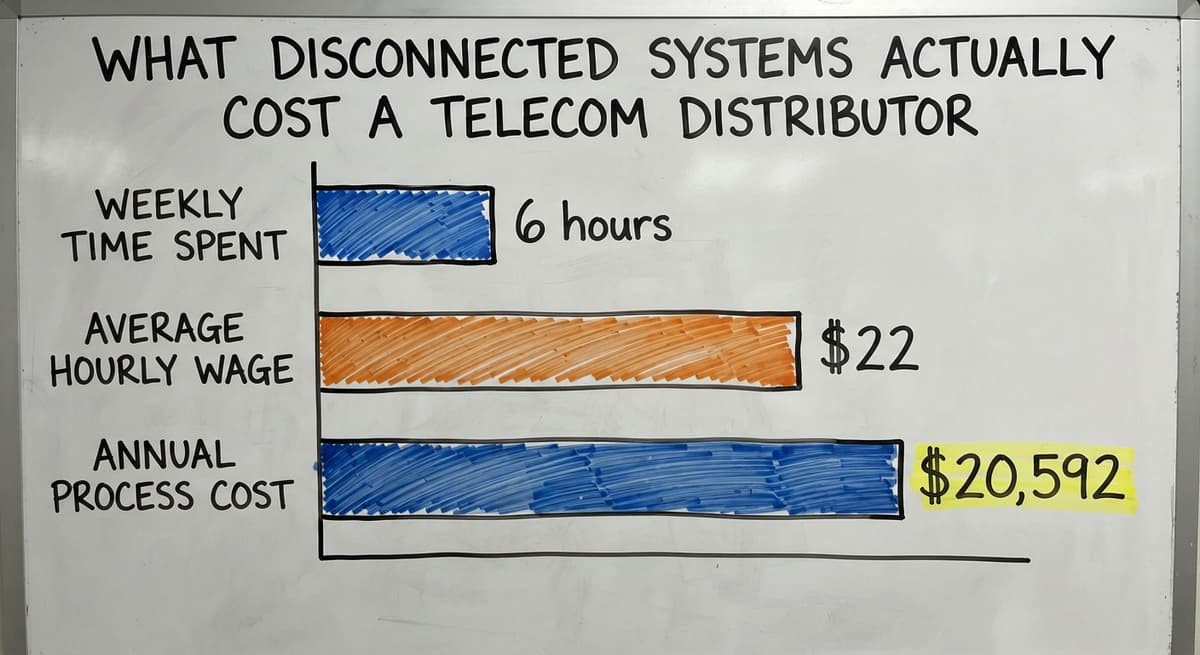
Disconnected systems create gaps. Consider 3 staff members spending 6 hours a week each reconciling spreadsheets, email orders, and accounting software entries at an average wage of $22 an hour. That is $20,592 a year spent on a process that a connected system removes. The US Bureau of Labor Statistics reports median wages for stock clerks and order fillers, and the math holds at almost any pay rate in that range. Errors that hide in those gaps cost more than the matching time alone.
Signs Your Current Telecom Inventory Process Is Breaking Down
Small and mid-size telecom distributors who have outgrown the tools they started with share a recognizable set of growing pains, and none of them are failures.
- Staff spend hours each week matching physical counts to spreadsheet rows that no longer reflect reality.
- Shipments leave the warehouse with the wrong device or a missing accessory, and the error surfaces only when the customer calls.
- Answering a stock question needs a walk to the warehouse rather than a glance at a screen.
- Month-end counts reveal shrinkage that no one can explain or trace to a specific transaction.
- Purchasing decisions rely on memory or a report that was current three weeks ago, which means you are either over-buying to feel safe or running out of fast-moving SKUs.
Any one of these is a signal. All five together mean the current process has reached its limit.
What Good Telecom Inventory Management Looks Like in Practice
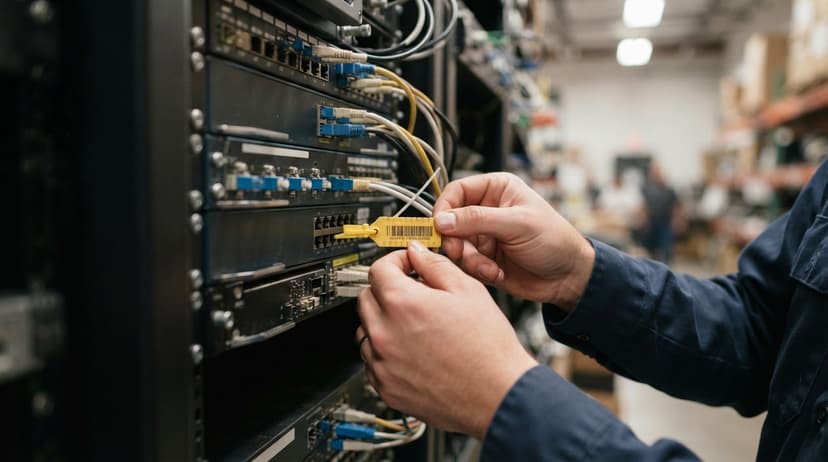
A practical example makes the difference concrete. A shipment of 200 handsets arrives at the dock. Each unit is scanned at receiving. The system assigns a bin location and records the IMEI against the buy order. Sales and fulfillment teams see the updated count in real time, before the pallet is even moved to the shelf.
When an order is picked, the picker scans the unit. The system confirms the IMEI matches the order. A mismatch stops the shipment before it leaves the building. The correct unit ships, and the transaction posts to your accounting software automatically. No one re-keys anything.
How Reorder Alerts and Right-Sized Software Complete the Workflow
When stock of a fast-moving SKU drops below a set threshold, the system flags a reorder suggestion. The buyer reviews it and approves a buy order in the same platform.
This workflow is achievable without a large ERP system. Inventory management software for wholesale distributors built at the right scale handles all of this in a lean operation, and the NIST Manufacturing Extension Partnership offers vendor-neutral guidance on building supply chain processes that match the actual size and structure of the business.
Not sure this is the right shape for your operation
Describe how the work runs today. We map it on a call and show you what it would look like built around that, before you spend anything.
Book a call
Choosing the Right Approach for a Small or Mid-Size Telecom Distributor
Off-the-shelf software often assumes a workflow that does not match how a telecom distributor actually operates. The result is staff working around the system rather than with it, which recreates the manual-process problem in a more expensive wrapper.
Custom working software for small distributors can be shaped around the operation as it already runs. That means less training time, less resistance from the team, and a system that handles carrier-specific SKU rules and serial number tracking the way the business actually needs them handled.
Five Questions to Ask Before Choosing a Telecom Inventory System
Before evaluating any option, ask these questions:
- Does it track at the serial and IMEI level, or only by SKU quantity?
- Does it connect to your accounting software without replacing it?
- Can it be configured to match specific carrier program rules and activation requirements?
- Will the team that builds it also support it when something changes?
- Is it sized for a 10- to 50-person operation, or is it built for a national carrier with a dedicated IT department?
A 10-person distributor does not need the same system as a regional carrier. Replacing Excel and manual processes with custom software works best when the system is built around the existing operation, not the other way around. Over-engineering a small operation creates cost and complexity that the business cannot absorb.
Where Should a Telecom Distributor Start?
The best first step is to write down what is actually breaking before looking at any solution. Document the specific pain points: where errors happen, how long matching takes each week, and which questions you cannot answer without walking the floor. That list becomes the requirements for any system you evaluate.
How Tighter Inventory Control Improves Wholesale Performance
Moving from manual processes to a purpose-built inventory system pays off in fewer errors, less shrinkage, and faster fulfillment. The US Census Bureau's Monthly Wholesale Trade data tracks inventories-to-sales ratios across wholesale firms, and tighter inventory control consistently improves that ratio by reducing dead stock and stockouts.
A local partner who builds custom working software can design a system around your existing workflow. That means no forced migration, no retraining on a platform built for someone else's business, and a system that grows as the operation grows.
If your current process is costing you time, product, or customer trust, the right next step is a conversation about your specific operation. Bring your pain-point list. A good partner will tell you honestly what a system built for your workflow would look like and what it would take to get there.
Frequently asked questions
What does inventory management mean in retail?
In retail, inventory management means tracking what products are on hand, where they are stored, and when to reorder. Retail inventory usually focuses on SKU quantities and shelf locations. Telecom retail adds a layer of complexity because individual units carry unique identifiers like IMEI numbers, so tracking by quantity alone is not enough.
What is network inventory management in the context of telecom?
Network inventory management in telecom refers to tracking the physical and logical assets that make up a carrier's network, things like fiber runs, cell towers, switches, and IP addresses. That is different from warehouse inventory management, which tracks the devices and accessories a distributor buys and sells. Both use the word 'inventory' but they describe separate disciplines.
What is large-scale enterprise resource planning software in inventory?
Large-scale enterprise resource planning software is a broad enterprise platform that includes inventory and supply chain modules. It is built for organizations with complex, multi-country operations and dedicated IT teams. For a small or mid-size telecom distributor, that kind of platform is almost always more than the operation needs. A purpose-built system connected to an existing accounting package handles the same core functions at a fraction of the cost and complexity.
How does ICT help in inventory management and data management?
Information and communications technology, or ICT, helps inventory management by replacing paper logs and manual counts with barcode scanning, real-time databases, and automated alerts. In a telecom warehouse, ICT tools capture IMEI and ICCID data at receiving, link each unit to an order at shipping, and push transaction data to accounting automatically. The result is a record that is accurate, searchable, and current without extra manual effort.
Do I need an ERP system to manage telecom inventory properly?
No. A large ERP system is built for organizations with hundreds of users and complex multi-entity accounting. A small or mid-size telecom distributor needs serial-level tracking, carrier SKU support, and a clean connection to an accounting package. Those functions can be delivered by a purpose-built system sized for the actual operation, without the cost or rollout burden of an enterprise platform.
What is the biggest risk of managing telecom inventory with spreadsheets?
The biggest risk is shrinkage that goes undetected. A spreadsheet records what someone types into it. It cannot catch a unit that leaves the building without a transaction, a receiving discrepancy that was never entered, or a pick error that shipped the wrong IMEI to a customer. By the time a spreadsheet-based operation finds the gap, the loss has already happened and the trail is cold.
How does the FTC's shipping rule connect to inventory accuracy?
The FTC's Mail, Internet, or Telephone Order Merchandise Rule needs sellers to ship within the time they promised or notify the customer and offer a cancellation option. An inaccurate inventory count leads to orders accepted for stock that is not actually available, which puts a distributor at risk of violating that rule. Accurate real-time stock visibility is the working control that keeps commitments honest.
Start with a free first look
A 30 minute call, your operation mapped, and a clear picture of what we would build. No obligation and nothing to install.
Book a callRelated guides
The rest of this guide, for the parts of the job this page does not cover.
- What is the Difference Between Aggregate and Item Inventory Management
- What is Jit Inventory Management
- What is an Important Factor in Inventory Management
- What is Abc Classification in Inventory Management
- What is Inventory Management in Working Capital
- What is Inventory Management and Its Types
- What is the Main Purpose of Inventory Management
- What is Effective Inventory Management
- What is Information Technology Inventory Management
- What is Risk Pooling in Inventory Management
- What is Inventory Management Mary Kay
- What is Stock Taking in Inventory Management
- What is Bin Number in Inventory Management
- What is the Goal of Inventory Management Quizlet
- What is the Implication of Proper Inventory Management
- What is Omni-channel Inventory Management
- What is Inventory Management and Its Importance
- What is the Importance of Eoq in Inventory Management
- What is the Importance of Quality Inventory Management
- What is Inventory Management Explain Techniques of Inventory Management
- What is Mean by Inventory Management
- What is Inventory Management Meaning in Hindi
- What is Inventory Management and Why is It Important
- What is the Rationale for Inventory Management Quizlet