


What Is Inventory Management In Healthcare
Reviewed and updated: October 2026
Inventory management in healthcare means tracking every supply, medication, and piece of equipment a facility uses so the right item is in the right place at the right time. It covers everything from bandages and exam gloves to high-cost surgical implants and controlled substances. When it works, care runs smoothly. When it breaks down, patients and budgets both pay the price.
Book a callThe Short Answer: What Does Inventory Management Mean in a Healthcare Setting?
Healthcare inventory management is the process of ordering, receiving, storing, and tracking every item a facility or supplier needs to operate. The goal is simple: never run out of what you need, never waste what you have, and always know where everything is. That applies whether you run a hospital supply room, a wholesale medical distributor, or a specialty fulfillment center serving clinics and surgical centers.
The stakes are higher than in most industries. A missing item is not a delayed shipment notice. It can mean a canceled procedure or a patient who does not get the care they need.
We build it for your operation, and the first look is free
If you would rather not compare products, describe how your operation already works and we build the system around it.
No build cost. You see it running on your own process first, and the monthly subscription starts only once it is live.
Book a callWhy Healthcare Inventory Is Different From Other Industries
Healthcare inventory control carries risks that retail and manufacturing simply do not face. Patient safety is on the line when a stockout occurs. A retailer loses a sale. A healthcare supplier who fails to deliver may delay a surgery.
Expiration dates create a hard deadline on every perishable item. Most industries write off slow-moving stock as a discount problem. In healthcare, expired product is a compliance problem and a safety risk.
Regulatory Tracking Requirements in Healthcare Inventory
Lot number tracking, serial number records, and chain-of-custody logs for controlled substances are not optional. Temperature-sensitive items need documented storage conditions. Manual tracking makes all of this harder and riskier.
GS1, the global standards body behind product barcodes, states that "barcodes are the foundation of supply chain visibility," and links their standards directly to patient safety outcomes at gs1.org/standards/barcodes. That visibility is exactly what breaks down when tracking is done by hand.
What Gets Tracked in a Healthcare Inventory System?
A healthcare inventory system tracks far more than boxes on a shelf. Each category below carries its own rules, and a good system handles all of them without requiring a separate process for each.
The main categories include:
- Consumable medical supplies: gloves, syringes, dressings, and tubing that are used once and replaced regularly
- Pharmaceuticals and controlled substances: items with strict lot number tracking, expiration date tracking, and regulatory records requirements
- Durable medical equipment (DME): wheelchairs, infusion pumps, and patient monitors that are reused and need serial number records
- Implants and surgical kits: high-cost items where lot numbers must be tied to a specific patient and procedure
- Administrative and working supplies: items that keep the facility running but do not touch patient care directly
Why Each Inventory Category Needs Its Own Rules
Each category may need different reorder rules, different storage conditions, and different audit trails. A system that treats all inventory the same way will create gaps in the categories that need the most oversight.
The comparison is easier when one option is built for you
Off-the-shelf means fitting your process to the software. We do it the other way round, and the first look costs nothing.
Book a callCore Functions of Healthcare Inventory Management
Healthcare inventory management handles several distinct tasks. Together, they keep stock levels accurate and operations running without gaps.
The core functions are:
- Receiving and logging incoming stock so every item is counted and recorded the moment it arrives
- Setting reorder points so the system flags low stock before a shortage happens rather than after
- FIFO rotation (first-in, first-out) so older stock ships or gets used before newer stock, cutting expired waste
- Cycle counting so staff check a rotating portion of inventory regularly rather than shutting down for a full physical count
- Usage tracking by department or procedure so leadership knows exactly where supplies are going
- Buy order generation and vendor management so buying is tied to real demand, not guesswork
When these functions run in sequence, inventory data stays accurate and purchasing decisions have a factual basis.

Common Problems That Signal Poor Inventory Control
Poor inventory control shows up in ways that operations managers recognize at once. These are not abstract risks. They are daily frustrations that cost real money.
Frequent stockouts force staff to scramble, delay procedures, or substitute items that were not the first choice. That scramble is expensive in both time and trust.
Expired supplies found on the shelf represent money already spent and now written off. A box of dressings that expired six months ago is not a storage problem. It is a tracking failure.
Overstocking ties up budget and floor space. Buying 3 months of supply when 3 weeks is enough means cash sitting on a shelf instead of working.
The Hidden Labor Cost of Poor Inventory Tracking
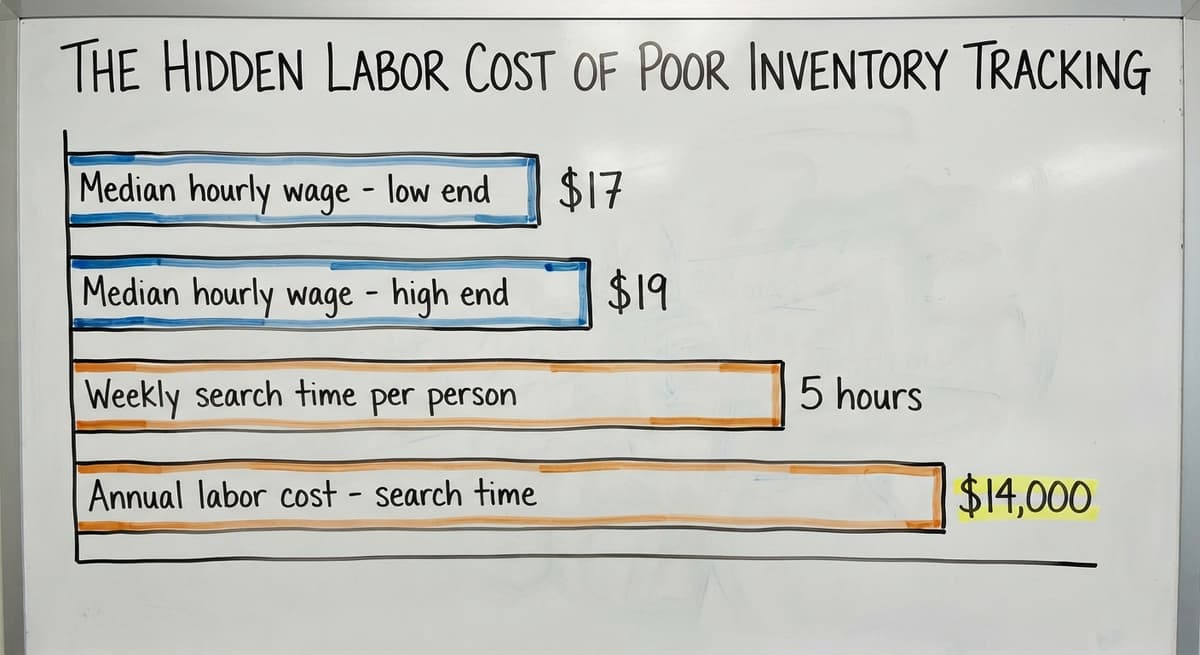
Staff who spend time hunting for supplies are not doing the work they were hired to do. The US Bureau of Labor Statistics shows that stock clerks and order fillers earn a median wage around $17 to $19 an hour. Three people spending 5 hours a week searching for misplaced items costs roughly $14,000 to $15,600 a year in labor alone, before you count what did not get done.
Discrepancies between system records and physical counts are the clearest sign that the tracking process has broken down.
Manual Tracking vs. a Dedicated Inventory System
Most operations start with spreadsheets. Someone builds a tab for each product, updates it after each order, and emails a copy to purchasing. That works when volume is low and locations are few.
The cracks appear fast as the operation grows. A spreadsheet updated by one person at the end of the day is already wrong by morning. Across 2 or 3 locations, version control becomes a full-time job. Lot number tracking and expiration date tracking done by hand invite errors that auditors and regulators will find.

What a Dedicated Inventory System Actually Does Differently
A dedicated inventory system automates the steps that cause the most errors. Reorder alerts fire when stock hits a set threshold. Lot numbers scan in at receiving rather than being typed later. Counts stay current because the system updates in real time rather than once a day.
The right system fits how staff already work. Replacing spreadsheets with a purpose-built inventory system is not about learning new software for its own sake. It is about removing the manual steps that create the most risk. A system that forces staff to change every habit they have will not be used correctly, which defeats the purpose entirely.
Key Metrics Healthcare Operations Should Monitor
Numbers tell the story that gut feel misses. Tracking the right metrics gives leadership a clear picture of how inventory is performing and where money is leaking.
The 4 metrics that matter most:
| Metric | What It Measures | Why It Matters |
|---|---|---|
| Inventory turnover rate | How often stock is fully used and replaced in a period | Low turnover means too much cash tied up in slow-moving stock |
| Days on hand | How long current stock will last at today's usage rate | Too high wastes space; too low risks a stockout |
| Shrinkage and waste rate | Expired, lost, or damaged items as a share of total inventory | Measures the true cost of poor tracking and storage |
| Fill rate | Orders fulfilled without a backorder or substitution | Directly reflects service reliability to customers or departments |
See it running on your own process first
No build cost. The subscription starts once it is live and doing the job, not before.
Book a callHow Metrics Shift Purchasing From Reactive to Planned
When these numbers are reviewed together on a regular cycle, purchasing decisions shift from reactive to planned. Leadership can see a problem building before it becomes a crisis.

How Inventory Management Connects to Broader Operations
Inventory data does its best work when it flows across the whole operation rather than sitting in a separate system no one else can read.
Purchasing and accounts payable need accurate stock data to avoid duplicate orders. When the inventory system and the accounting package share the same numbers, the check against over-ordering happens automatically.
Billing accuracy depends on capturing item usage at the point of care or at the point of fulfillment. When a supply is used and recorded in real time, the charge follows at once. When it is recorded later from memory, charges get missed.
Compliance reporting becomes far less painful when lot numbers and expiration dates are already in the system. An auditor asking for the chain of custody on a specific lot gets an answer in minutes, not days.
Inventory Records as a Legal and Financial Obligation
The IRS is direct on why this data must be maintained: IRS Publication 538 states, "To figure taxable income, you must value your inventory at the beginning and end of each tax year." That is a legal obligation, not a suggestion, and it is far easier to meet when records are current rather than reconstructed at year-end.
Inventory management software for distributors works best when it connects to the financial and working tools already in use, rather than creating yet another data silo to reconcile.
What Should a Smaller Healthcare Supplier Look for in an Inventory Solution?
The right inventory solution fits the size and complexity of the operation. That is the first question to answer before evaluating any system.
Large hospital ERP platforms are built for large hospital budgets and large IT teams. A wholesale medical distributor or specialty fulfillment center does not need that scale. It needs a system that handles medical supply tracking correctly, connects to existing accounting tools, and does not need a full-time administrator to keep running.
Look for these qualities:
- Fits current scale without charging for features that only apply to a 500-bed hospital system
- Connects to existing accounting or practice management software so data flows rather than being re-entered
- Can be configured around current workflows so staff adoption happens naturally rather than by force
- Provides real-time visibility across all locations from a single view
- Supported by people who understand operations, not just the software itself

Custom vs. Off-the-Shelf: How Integration and Fit Drive Adoption
Custom operations software vs. off-the-shelf ERP is a real decision point here. A purpose-built system designed around how the operation actually runs will be used. A generic platform that needs the operation to reshape itself around the software will not.
How accounting software integration works with custom inventory tools is a common question for smaller distributors. The short answer is that a well-built inventory system passes buy orders, receipts, and cost data directly to the accounting package without manual re-entry. That connection alone removes a large share of the errors that plague manual processes.
Not sure this is the right shape for your operation
Describe how the work runs today. We map it on a call and show you what it would look like built around that, before you spend anything.
Book a callExternal Resources for Evaluating Inventory Fit at Smaller Scale
The NIST Manufacturing Extension Partnership offers vendor-neutral guidance on supply chain process improvement that applies directly to distributors and suppliers at this scale. Their framework emphasizes fitting the process to the operation rather than the other way around.
The US Census Bureau's Monthly Wholesale Trade data tracks inventories-to-sales ratios across wholesale sectors. When that ratio rises, it signals that distributors are holding more stock relative to what they are selling, which is exactly the kind of trend a good inventory system helps a business detect and correct before it becomes a cash flow problem.
The Real Cost of Getting This Wrong
Operations managers sometimes treat inventory tracking as a back-office task that can wait. The numbers say otherwise.
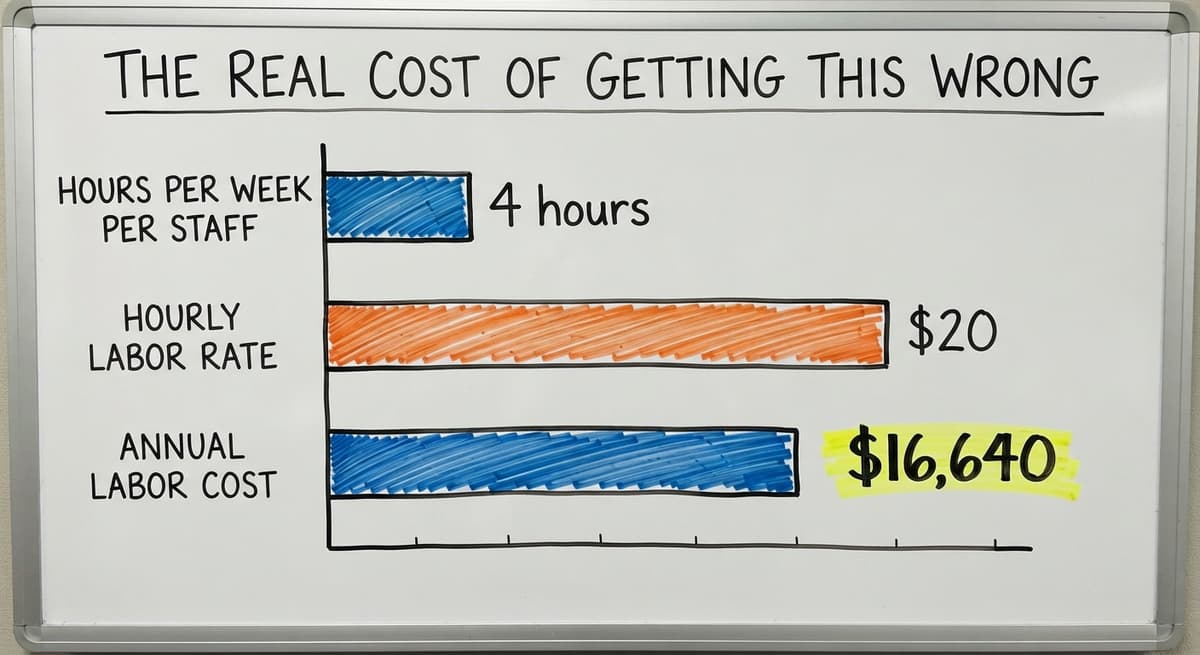
Consider a distributor with 4 staff members each spending 4 hours a week on manual matching, at $20 an hour. That is $16,640 a year in labor devoted to a process that a system could handle in minutes. That figure does not include the cost of the errors those hours still produce.
Expired stock written off at cost is a direct loss. Overstocked items that expire before use represent buying decisions made without accurate data. Both are preventable with the right tracking in place.
The US Federal Trade Commission requires that sellers ship merchandise when promised. Accurate inventory is what makes that promise possible. A distributor who cannot see real stock levels cannot make a reliable commitment to a customer or a care facility.

Building a System That Grows With the Operation
The goal is not to buy the most powerful system available. The goal is to build or adopt a system that handles today's volume correctly and can scale as the operation grows, without requiring a full replacement every few years.
That means starting with the workflows that cause the most errors right now. Receiving? Reorder timing? Lot number tracking? Fix the biggest leak first, then build from there.
A system that is configured around real operations, connected to the tools already in use, and supported by people who understand the business will outperform a larger, generic platform that no one uses correctly.
Smaller healthcare distributors and suppliers are not a smaller version of a hospital system. They have their own rhythms, their own vendor relationships, and their own compliance needs. The right inventory solution reflects that rather than ignoring it.
Conclusion: Inventory Management in Healthcare Is an Operational Foundation
Healthcare inventory management is not a software category. It is a set of decisions about how a business tracks what it has, what it needs, and what it owes to the customers and care facilities it serves.
For a smaller distributor or supplier outgrowing spreadsheets, the path forward is clear: identify the tracking gaps causing the most pain, choose a system that fits the operation rather than demanding the operation fit the system, and connect that system to the financial and working tools already in place.

The Business Case for Acting Before the Next Stockout or Audit
When inventory data is accurate and accessible, everything downstream gets easier. Purchasing is smarter. Billing is cleaner. Compliance is faster. And the team spends its time on work that moves the business forward rather than hunting for stock or reconciling counts.
If your operation is at that inflection point, the next step is a clear-eyed look at where the current process is breaking down and what a purpose-built system would actually need to do. That conversation is worth having before the next stockout or audit forces it.
Frequently asked questions
What is the role of inventory management in healthcare?
Inventory management in healthcare ensures that the right supplies, medications, and equipment are available when and where they are needed. It prevents stockouts that can delay patient care, reduces waste from expired or overstocked items, and provides the records that compliance and billing depend on. For distributors and suppliers, it also protects the reliability of delivery commitments to care facilities.
What are the 5 steps of inventory management?
The 5 core steps are: (1) receiving and logging incoming stock, (2) storing items correctly and updating counts, (3) tracking usage as items leave the shelf or ship to customers, (4) setting reorder points so stock is replenished before it runs out, and (5) auditing counts through cycle counting or periodic physical checks to catch discrepancies early. In healthcare, each step also carries records requirements tied to lot numbers, expiration dates, or regulatory rules.
What are the four main types of inventory management?
The four main approaches are: (1) periodic inventory, where counts are done at set intervals such as monthly or quarterly; (2) perpetual inventory, where every transaction updates the count in real time; (3) just-in-time inventory, where stock arrives as close to the point of use as possible to minimize storage; and (4) consignment inventory, where a supplier holds stock at the buyer's location and the buyer pays only when items are used. Healthcare operations most often use perpetual inventory because real-time accuracy is critical for patient safety and compliance.
What is inventory management in simple words?
Inventory management means knowing what you have, knowing where it is, and making sure you never run out of what you need or waste money holding too much of what you do not. In healthcare, it also means knowing when items expire and being able to prove where every item came from and where it went.
What is the difference between cycle counting and a full physical inventory count?
A full physical count stops operations while staff count every item at once. Cycle counting breaks that work into smaller pieces, counting a portion of inventory on a rotating schedule so the whole inventory gets checked over time without shutting down. Most healthcare distributors prefer cycle counting because it catches errors faster and does not need a shutdown.
Why does FIFO matter in healthcare inventory?
FIFO stands for first-in, first-out. It means the oldest stock ships or gets used before newer stock. In healthcare, this is critical because supplies and pharmaceuticals carry expiration dates. Sending out the oldest items first reduces the chance that stock expires before it is used, which cuts waste and protects patients from receiving items past their use-by date.
What is a reorder point and how is it set?
A reorder point is the stock level at which a new buy order should be placed so the item is replenished before it runs out. It is set by looking at how fast an item is used and how long it takes to arrive after ordering. For example, if an item is used at a rate of 50 units per week and takes 2 weeks to arrive, the reorder point should be set at 100 units, plus a safety buffer for unexpected demand spikes.
Start with a free first look
A 30 minute call, your operation mapped, and a clear picture of what we would build. No obligation and nothing to install.
Book a callRelated guides
The rest of this guide, for the parts of the job this page does not cover.
- What is the Difference Between Aggregate and Item Inventory Management
- What is Jit Inventory Management
- What is Kanban System of Inventory Management
- What is the Definition of Inventory Management
- What is an Important Factor in Inventory Management
- What is Abc Classification in Inventory Management
- What is Inventory Management in Working Capital
- What is Poor Inventory Management
- What is Inventory Management and Its Types
- What is the Main Purpose of Inventory Management
- What is Inventory Management in Pharmacy
- What is Effective Inventory Management
- What is Information Technology Inventory Management
- What is Risk Pooling in Inventory Management
- What is Inventory Management Mary Kay
- What is Stock Taking in Inventory Management
- What is Bin Number in Inventory Management
- What is the Goal of Inventory Management Quizlet
- What is the Implication of Proper Inventory Management
- What is Omni-channel Inventory Management
- What is Inventory Management and Its Importance
- What is the Importance of Eoq in Inventory Management
- What is the Importance of Quality Inventory Management
- What is Inventory Management in Restaurant